Translate Your Page

Showing posts with label History of Ancient India. Show all posts

Thursday, January 10, 2019

History Of Education In South Asia

The remnants of the library of Nalanda, built in the 5th century BCE by Gupta kings. It was rebuilt twice after invasion, first after an invasion from the Huns in the 5th century BCE and then after an invasion from the Gaudasin the 7th century CE but abandoned after the third invasion by Turkic invaders in the 12th century.

Takshasila (in modern-day Pakistan) was the earliest recorded centre of higher learning in India from possibly 8th Century BCE, and it is debatable whether it could be regarded a university or not in modern sense, since teachers living there may not have had official membership of particular colleges, and there did not seem to have existed purpose-built lecture halls and residential quarters in Taxila, in contrast to the later Nalanda university in eastern India. Nalanda was the oldest university-system of education in the world in the modern sense of university. There all subjects were taught in Ariano -páli Language.[159]
Secular institutions cropped up along Buddhist monasteries. These institutions imparted practical education, e.g. medicine. A number of urban learning centres became increasingly visible from the period between 500 BCE to 400 CE. The important urban centres of learning were Nalanda (in modern-day Bihar) and Manassa in Nagpur, among others. These institutions systematically imparted knowledge and attracted a number of foreign students to study topics such as Buddhist Páli literature, logic, páli grammar, etc. Chanakya, a Brahmin teacher, was among the most famous teachers, associated with founding of Mauryan Empire.
Sammanas and Brahmin gurus historically offered education by means of donations, rather than charging fees or the procurement of funds from students or their guardians. Later, stupas, temples also became centres of education; religious education was compulsory, but secular subjects were also taught. Students were required to be brahmacaris or celibates. The knowledge in these orders was often related to the tasks a section of the society had to perform. The priest class, the Sammanas, were imparted knowledge of religion, philosophy, and other ancillary branches while the warrior class, the Kshatriya, were trained in the various aspects of warfare. The business class, the Vaishya, were taught their trade and the working class of the Shudras was generally deprived of educational advantages.

Chalukas Dynasty and Pallava Dynasty


THE CHALUKYAS

History of the Chalukyas, the Karnataka rulers, can be classified into three eras:

1) The early western era (6th -8th century), the Chalukyas of Badami (vatapi);

2) The later western era (7th - 12th century), the Chalukyas of Kalyani;

3) The eastern chalukya era (7th - 12th century), the chalukyas of Vengi.

1) Pulakesin I (543-566) was the first independent ruler of Badami with Vatapi in Bijapur as his capital.

2) Kirthivarma I (566-596) succeeded him at the throne. When he died, the heir to the throne, Prince Pulakesin II, was just a baby and so the king‘s brother, Mangalesha (597-610), was crowned the caretaker ruler. Over the years, he made many unsuccessful attempts to kill the prince but was ultimately killed himself by the prince and his friends.

3) Pulakesin II (610-642), the son of Pulakesin I, was a contemporary of Harshavardhana and the most famous of the Chalukyan kings.His reign is remembered as the greatest period in the history of Karnataka. He defeated Harshavardhana on the banks of the Narmada.

4) After conquering the Kosalas and the Kalingas, and eastern Chalukyan dynasty was inaugurated by his(Pulakeshin II) brother Kubja Vishnuvardana.

5) By 631, the Chalukyan empire extended from sea to sea. However, Pulkeshin II was defeated and probably killed in 642, when the Pallavas under Narsimhavarma I attack on their capital & captured the chalukyan capital at Badami.

6) The Chalukyas rose to power once again under the leadership of Vikramaditya I (655-681), who defeated his contemporary Pandya, Pallava, Cholas and Kerala rulers to establish the supremacy of the Chalukyan empire in the region.

7) Vikramaditya II (733-745) defeated the Pallava king Nandivarma II to capture a major portion of the Pallava kingdom.

8) Vikramaditya II‘s son, Kirtivarma II (745), was disposed by the Rastrakuta ruler, Dhantidurga, who established the Rashtrakuta dynasty.

PALLAVA DYNASTY

1) The Pallava dynasty emerged in South India at a time when the Satavhana dynasty was on the decline.

2) Shivaskandavarman is said to have been the founder of the Pallava dynasty.

3) During their reign, the Pallava rulers made Kanchi their capital.

4) The noteworthy rulers during this period were:

Simhavarama I Sivaskkandavarma I, Veerakurcha, Shandavarma II, Kumaravishnu I, Simhavarma II, and Vishnugopa.

Note: Vishugopa is said to have been defeated in battle by  Samudragupta after which the Pallavas become weaker.

5) It was Simhavishnu, the son of Simhavarma II, who eventually crushed the Kalabhras‘ dominance in 575 AD and re-established his kingdom.

6) In 670, Parameshwaravarma I came to the throne and restricted the advance of the Chlukyan king Vikramaditya I. However, the Chalukyas joined hands with the Pandya king Arikesari Maravarma, another promients enemy of the Pallavas, and defeated Parameshwaravarma I.

7) Parameshwaravarma I died in 695 and was succeeded by Narasimhavarma II, a peace living ruler.He is also remembered for building the famous Kailashanatha temple at Kanchi. He died grieving his elder son‘s accidental death in 722.

8) His youngest son, Parameshwaravarma II, came to power in 722.He died in 730 with no heirs to the throne, which left the Pallava kingdom in a state of disarray.

9) Nandivarma II came to power after some infighting for the throne among relatives and officials of the kingdom. Nandivarma married the Rashtrakuta princess Reetadevi, and re-established the Pallava kingdom.

10) He was succeeded by Dantivarma (796-846) who ruled for 54 long years. Dantivarma was defeated by the Rastrakuta king, Dantidurga, and subsequently by the Pandyas. He was succeeded by Nandivarma III in 846.

Gupta Empire and it's Details

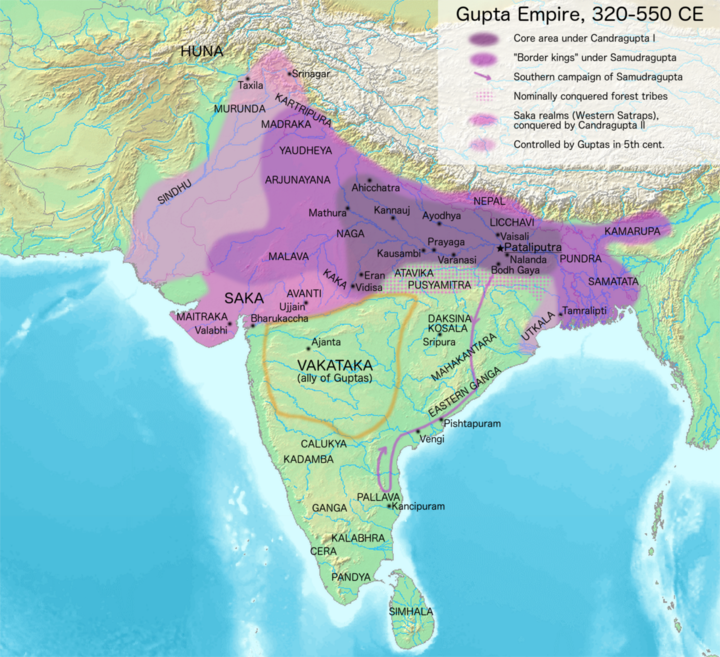
Gupta Empire

The start of Gupta Empire is considered by many historian from the reign of Maharaja Shrigupta.

Chandragupta-I was the first powerful ruler of Gupta Empire and ascended the throne in 320 AD.

The Gupta Period from 320 AD to 550 AD is also known as the Golden Age of India.

In the Gupta period India attained the peak of glory in every aspects starting from science, art, literature, mathematics, astronomy and philosophy.

Emperors of Gupta Empire

Shrigupta and Ghatotkacha. The reign of Maharaja Shrigupta (240 AD to 280 AD) is considered by many historians to be the starting point of Gupta Empire.

Ghatotkacha succeeded his father Shrigupta and ruled from 280AD to 319 AD.

Chandragupta I

Chandragupta I was the son of Ghatotkacha and succeeded his father. He was the first powerful king of the dynasty. He ruled the Empire from 320 AD to 335 AD.

Chandragupta I adopted the title of Maharajadhiraja: meaning King of Kings.

He married princess Kumaradevi of neighboring kingdom Lichchhavi and gained the control of the territory of north Bihar.

The starting of the reign of Chandragupta-I is considered by many historians as the beginning of Gupta era.

Samudragupta and Chandragupta II

Samudragupta,succeeded his father Chandragupta I and ruled the Gupta dynasty for about 45 years from 335 AD to 380 AD. He is also known as 'Napolean of India'.

Many historians believe that Chandragupta II was nominated by his father Samudragupta as the next heir of Gupta Empire.But Ramagupta,the eldest son of Samudragupta succeeded his father and became the emperor.

Chandragupta II killed him and ascended the throne. He was an extremely powerful emperor. Chandragupta II is most commonly known as Vikramaditya,ruled the Gupta Empire from 380 AD to 413 AD.

Other Emperors

Kumaragupta I,the son of Chandragupta II succeeded his father and ruled the dynasty till 455 AD. After Kumaragupta I, Skandagupta succeeded his father.

He is considered to be the last of the great Gupta emperors.

He also adopted the title of Vikramaditya.

After Skandagupta, the Gupta dynasty didn't get any powerful ruler and finally the dynasty was overpowered by the Vardhana ruler Harshavardhana.

Note:Some of the weak rulers who ruled after Skandagupta were, Purugupta, Kumaragupta II, Budhagupta, Narasimhagupta, Kumaragupta III, Vishnugupta, Vainyagupta and Bhanugupta.

Fa-hien's India Visit

Fa-hien was the first Chinese pilgrim who visited India during the reign of Gupta emperor Chandragupta II.

Nine Gems or Navaratnas

At the time of Vikramadityas reign, the glory of Gupta Empire reached its peak.

A circle of famous nine persons known as Nine Gems or Navaratnas were present in the court of Vikramaditya.

The group comprised of

Kalidasa

Vetala Bhatta

Varahamihira

Vararuchi

Amarasimha

Dhanvantari

kshapanak

Shanku

Ghatakarpura

Kalidasa

Kalidasa was a famous Sanskrit writer and poet in the court of Chandragupta II (Vikramaditya).

Kalidasa was the author of three famous plays.

Abhijnanasakuntalam : tells the story of King Dushyanta and Shakuntala

Malavikagnimitram tells the story love of King Agnimitra with Malavika

Vikramorvasiyam tells the love story of King Pururavas and celestial fairy Urvashi

Kalidasa was also the author of two famous Sanskrit epic poems:

Raghuvamsa ("Raghu Dynasty ") and

Kumarasambhava.

Vetala Bhatta

Vetala Bhatta was a Brahmin in the court of Vikramaditya.

He is known for his contribution of "Nitipradipa ".

Varahamihira

Varahamihira was an Indian astronomer, astrologer and mathematician of Gupta era.

He is famously known for his great work Pancha Siddhantika,a book on mathematical astronomy.

His other important contribution to the Indian Sanskrit literature is the Brihat-Samhita, an encyclopedia of astrology and other subjects of human interest.

Vararuci

Vararuci was one of the nine Gems in the court of Chandragupta II of Gupta era.

Amarasimha

Amarasimha was one of the nine Gems in the court of Vikramaditya of Gupta era.

He is notably known for his famous Sanskrit thesaurus Amarakosha.

It is also known as Namalinganushasana.

Dhanvantari

Dhanvantari is regarded as one of the worlds first surgeons and medical practitioner from Gupta era.

He is considered as the origin exponent of Ayurveda.

He is also worshipped as the God of Medicine.

Sushruta, the author of famous Sushruta Samhita was the student of Dhanvantari.

He is also credited for the discovery of the antiseptic properties of turmeric and the preservative properties of salt.

Dhanvantri is considered to be the pioneer of modern plastic surgery.

Dynasties of Ancient India

Indo Greeks

First to invade India were the Greeks who were called Indo-Greeks.

The most famous Indo-Greek ruler was Menanderwith his Capital at Sakala in Punjab (Modern Sialkot)

The Indo-Greeks were the first to issue gold coins in India.

Menander was converted into a Buddhist by Buddhist monk Nagasena (Nagarjuna)

Demitrius, the king of Bacteria invaded India about 190BC. He is considered as Second Alexander (But the Indian ruler who accepted the name second Alexander (Sikandar-i-sani) was Alauddin Khilji) Indo-Greeks were the first to introduce military
governorship in India.

Kushan Empire

Kujula Kadphises is considered to be the founder of Kushan Empire. He established the kingdom by unifying the disparate Yuezhi tribes of ancient Bactria in the early 1st century AD and expanded its territory of present day Afghanistan, Pakistan, southern Tajikistan and Uzbekistan.

He established the capital of Kushan Empire near Kabul.

During the period of first to mid-third centuries AD, Kushan expanded rapidly and represented as a major power in Central Asia and northern India.

The most famous Kushana ruler was Kanishka. He became the ruler in 78 AD and started Saka Era in 78 AD.

The Capital of Kanishka was Peshawar or Purushapura. Kanishka convened the fourth Buddhist council in Kashmir.

The Gandhara School of Art received royal patronage under the Kushans. Kanishka patronised Mahayana form of Buddhism.

The first month of Saka era is Chaithra and the last month is Phalguna.

Vasudeva was the last great king of Kushana Dynasty.

Kushana school of art is also referred to as the Mathura school.

Sunga Dynasty

Sunga dynasty was established by Pusyamitra Sunga in 185 BC after assassinating the last Mauryan emperor Brihadratha.

The capital of Sunga Dynasty was Pataliputra of ancient Magadha.

Kalidasa’s drama Malavikagnimitram is about the love story of Pushyamitra’s son Agnimitra and

Last King of sunga dynasty was Devabhuti. he ruled the kingdom from 83 to 73 BC

Patanjali's Yoga Sutras and Mahabhasya were composed in this period. The ancient Sanskrit grammar, Ashtadayayi by Panini was composed during the period of Sunga Period.

Kanva Dynasty

Kanva dynasty was founded by Vasudeva Kanva in 72 BC after defeating the last Sunga ruler Devabhuti.

This dynasty ruled for a period of 45 years.

Vasudeva, Bhumimitra, Narayana and Susuman were the rulers of Kanva dynasty.

Satavahana Dynasty

Satavahanas were the most powerful ruling dynastyafter the Mauryas.

Satavahanas were also known as Andhras.

Satavahanas were the Indian rulers who prefixed their mother’s name along with their names.

Most important Satavahana ruler was Gautamiputra Satakarni. Satavahanas were Brahmanas.

Nagarjuna Konda and Amaravati in Andhrapradesh became important seats of Buddhist culture under the Satavahanas.

The two common structures of Satavahanas were the temple called Chaitya and the monastery called Vihara.

The official language of the Satavahanas was Prakrit

The Cholas

Vijayalaya was the founder of the Chola empire. He was a feudatory of the Pallavas of Kanchi.

Raja Raja I (985 - 1014) adopted the titles of Arumudivarman, Mammudichodadeva, Jaykonda, Marthanda Chola, Mamudichola etc. He built the Brihadeshwara temple at Tanjavur. which is called the RajaRajeswara temple.

Rajendra I led an expedition to North India, defeated the Pala ruler Mahipala I and adtoped the title, Gangaikondachola and established a new Capital, Gangai Konda Cholapuram. Cholas maintained a well established local – self government system. Ur, Sabha or Mahasabha - and Nagaram were the assemblies for local administration.

The Uttaramerur inscription of Dantivarman Pallava gives details about the local self government.

Mughal Empire


Jahangir (1605 - 1627)

Jahangir came to the throne in 1605. He issued 12 ordinances. He established Zanjir-il-Adal – Chain of Justice in Agra Fort and was known for his strict administration of Justice.

He married Mehrunnisa, an Afghan widow in 1611 and Later he gave her the titles Noor Mahal (light of the palace), Noor Jahan (light of the world) and Padshah Begum.

In 1606 Jahangir executed fifth Sikh Guru, Guru Arjun Dev, because he helped Jahangir’s son Prince Khusru to rebel against him.

In 1609, Jahangir received William Hawkins, an envoy of King James I of England, who reached India to obtain trade concession.

In 1615, Sir Thomas Roe reached the court of Jahangir as the first ambassador of James I of England in the court of Jahangir. As a result of his efforts, first English factory was established at Surat in Gujarat.

Period of Jahangir is considered as the Golden Age of Mughal Painting. Jahangir himself was a painter. Ustad Mansur and Abul Hassan and Bishan das were famous painters in the court of Jahangir.

Anarkali was Jahangair’s lover. Mughal-i-Azam directed by K. Asif is a famous film which tells the love story of Jahangir and Anarkali.

Jahangir wrote his autobiography Tuzukh-i-Jahangiri in Persian language.

Jahangir died in 1627 and was cremated at Shahdara in Lahore.

Architecture:

Jahangir built Shalimar and Nishant Gardens in Srinagar.

He completed the tomb of Akbar at Sikandara

Jahangir introduced the vigorous use of Marble instead of red sandstone and use of Pietradura for decorative purposes. Nurjahan built Itimad-ud-daula/Mirza Ghiyas Beg’s Marble tomb at Agra

He built Moti Masjid at Lahore and his own mausoleum at Shahdara

Shah Jahan (1628 - 1658)

Shah Jahan was born on 5th January 1592 at Lahore. His childhood name was Khurram. He ascended the throne in 1628.

He married Arjumand Benu Begum, daughter of Asaf Khan, brother of Noor Jahan. She later came to be known as Mumtaz Mahal which means beloved of the Palace.

Shahjahan destroyed the Portuguese settlements at Hoogly in 1631-32.

The Gateway of Red Fort is the Lahore Gate. It is here at the Lahore Gate that the Prime Minister of India hoists the National Flag and addresses the nation on the Independence Day.

In 1656 Shahjahan constructed the Jama Masjid in Delhi. It is the biggest masjid in India. The first masjid in India was constructed at Kodungallur in Kerala (Cheraman Palli) in 644 AD by Malik Ibn Dinar.

Shah Jahan’s period is known as the Golden Age of Mughal Empire.

The Portuguese introduced European painting in India during the reign of Shah Jahan

In 1658 Shah Jahan was imprisoned by his son Aurangzeb and he died in 1666, after eight years. His daughter Jahan Ara was also kept in prison along with him at the Agra Fort.

Shah Jahan’s son Dara Shikoh was a famous scholar. He translated Bhagavat Gita and Sixty Upanishads into Persian. He also wrote a book titled Mujm-ul-Behrain (Mingling of the Oceans) He also translated Atharva Veda into Persian.

Shah Jahan was a famous lyricist who wrote in Hindi. The famous Peacock Throne was built by Shah Jahan. It was abducted from here by Nadir Shah in 1739 during his Indian invasion (Persian conqueror). Now it is kept at the London Tower Museum, Britain.

French travelers Bernier and Tavernier, Italian travelers Nicoli Manucci, Peter Mundi visited India during Shah Jahan’s period.

Architecture:

Shah Jahan’s period is considered as the Golden Age of Mughal Architecture and Shah Jahan is known as the Prince of Builders.

In 1631, he started the construction of Taj Mahal in memory of his wife and completed in 1653. Ustad Iza, a Turkish/ Persian was its architect. British administrator Furguson called it ‘a love in marble’

In 1638 Shah Jahan built his new capital Shahjahanabad in Delhi and shifted the capital from Agra to there. He also built Takht-i-Taus or Peacock throne.

In 1639, he started the construction of Red Fort in Delhi on the model of Agra fort built by Akbar. The Diwan-i- Aam, Diwan-i-Khas and the Moti Masjid are situated inside the Red fort. The Moti Masjid in Agra was constructed by Shah Jahan.


Medieval History Notes: Bengal


Murshid Kuli Khan:

Murshid Quli Khan was appointed as Bengal’s diwan by Aurangzeb as naib subedar and later as the subedar in 1717 by Farukh Siyar.

He gradually assumed autonomy though he continued to pay tribute to Mughal Emp

He carried out the reorganization of the finances through the transfer of large parts of jagir lands into khalisa lands.

He introduced the system of revenue farming.

He granted Takkavi loans to peasants for personal use, improved agriculture and for paying land revenues in times of famines.

He reorganized administration giving equal opportunities of employment to Muslims and Hindus.

His policy of appointing local Hindu zamindars and moneylenders as revenue farmers led to the rise and growth of a new landed aristocracy in Bengal.

He maintained strict control over the activities of foreign trading companies; preventing the servants of East India Company from abusing the privileges granted to the company by the Mughal farmans of 1691 and 1717. He established law and order in the province by suppressing the rebellious zamindars.

Alivardi Khan:

Alivardi Khan came to the throne after murdering the heir to the throne in 1740.

He legalized his usurpation by receiving a farman from emperor Muhammad Shah after paying him Rs 2 crore.

During his reign there were continuous incursions of the Marathas into Bengal.

He agreed to their demands of revenues from part of Orissa and annual payment of Rs 12 lakh as the chauth of Bengal in exchange for peace. 

He prevented the English form misusing their privileges and prohibited them and French from fortifying their factories at Calcutta and Chandannagore.

Siraj-ud–Daula :

Siraj-ud Daula came to power in 1756.

Calcutta was renamed Alinagar after its capture by Siraj-udDaula.

He tried to control the activities of East India Company.

He wrote letters to the British governor of Calcutta to demolish additional fortifications and also to stop unlawful activities against him.

The British refused to comply with his orders and he seized the English factory at Kasimbazar and then Calcutta.

In 1757, his men were attacked by English army led by Robert Clive. This forced the nawab to come to an understanding and establish peace with the English.

Treaty of Alinagar (1757)

The treaty comprised:

A list of demands made by the Company

An agreement affirming to return to status quo

A number of farmans and dastaks issued by the nawab

As long as nawab shall observe his agreement,English will continue to support him.

All the trade privileges held earlier by the Company stood confirmed.

Additionally, the English were authorized to fortify Calcutta against possible French attack and issue their coins.

Battle of Plassey (23 June 1757)

The treaty was violated by conquest of Chandannagore by the British in 1757.

Siraj ud –Dhaula protested by offering protection to the French.

The British decided to remove him through conspiracy.

The battle of Plassey took place on June 23, 1757.This battle saw the treachery of Mir Jafar and Rai Durlabh,bravery of small force and desertation of Nawab’s army. Siraj-ud –Dhaula was captured and executed by son of Mir Jafar.

Mir Jafar (1757-60)

Mir Jafar granted the right to free trade in Bengal and Bihar and Orissa and zamindari of the 24 parganas to the British besides paying them a sum of Rs 17.7 million as compensation.

His period saw the beginning of the drain of wealth from India to Britain.

He tried to replace the English with the Dutch but the Dutch were defeated by the English at Bedara in 1759.

Mir Qasim (1760-63)

He introduced several revenue and military reforms to strengthen his position.

His period saw the beginning of the conflict between the Nawab and the British for sovereign power.

He transferred his capital from Murshidabad to Mongher.

He stopped the misuse of the dastaks or free passes allowed to the company and abolished all duties on internal trade against British.

Battle of Buxar (1764)

Mir Qasim fought against the British along with three allies – Shuja-ud-Daula of Awadh and Shah Alam II.This battle led to their defeat by the British forces under Major Hector Munro.

GK Medieval History Notes: Awadh

Shuja-ud-Dhaula :

Shuja-ud-Dhaula ascended the throne of Awadh as well as wazirship of Mughal Empire in 1754.

He had fought against British in Battle of Buxar in 1764 but has to concede Allahabad and Kara. He had to pay huge indemnity to the British.

Under Lord Hastings he was forced to sign Treaty of Benaras in 1773.

In this treaty, British got the right to station their armies in Awadh for his protection.

He defeated Rohillas with the help of British and annexed Rohillakand to Awadh in 1774.

Asaf-ud-Dhaula:

Asaf-ud-Dhaula signed Treaty of Faizabad with British in 1775. Under this treaty,they will not encourage their peasants in committing hostilities.

Nawab would not entertain Mir Qasim.

Nawab gave British authority over all the districts.

Nawab would pay 6 lakh per month for maintaining the British army.

Wajid Ali Shah:

Lord Dalhousie annexed Awadh in 1856 and pensioned off the Nawab to Calcutta.


Vedic Period and the Aryans


The Aryans were semi-nomadic pastoral people and originated from the area around the Caspian Sea in Central Asia(Many historians have given various theories regarding their original place). The Central Asian theory is given by Max Muller.

Entered India probably through the Khyber Pass(Hindukush mountain) around 1500 BC.

Early Vedic or Rig Vedic Period(1500- 1000 BC)

Political Organization

Monarchial form. The tribe was known as Jan and its king as Rajan.

The family was the basic unit of society. The family was patriarchal in nature.

Economy

Aryans followed a mixed economy i.e pastoral and agricultural in which cattle played a predominant part.

The standard unit of exchange was Cow. At the same time coins were also there.

Religion

The Aryans personified the natural forces and looked upon them as living beings.

The most important divinity was Indra who played the role of the warlord(breaker of forts-Purandar)


Later Vedic Period(1000- 600 BC) (Painted Gray Ware Phase)

Political Organization

Tiny tribal settlements were placed by strong kingdoms.

Social

The fourfold division of society became clear, initially based on occupation, which later became hereditary: Brahmins(priests), Kshatriyas(warriors), Vaishyas(agriculturists, cattle- rearers, traders), Shudras(servers of the upper three).

The institution of the gotra appeared for the first time in this age.

Religion

Indra and Agni lost their importance. Prajapati(the creator) became supreme. Vishnu came to be conceived as the preserver and protector of the people.

The Vedic Literature

The Vedas

The word Veda comes from the root "vidi" signifying knowledge. They are four in all - Rig Veda, Sama Veda, Yajur Veda and Atharva Veda.


(1) Rig Veda

Oldest religious text in the world.

Contains 1,028 hymns and is divided into 10 mandalas.

(2) Sama Veda

Derived from the root Saman i.e "melody". It is a collection of melodies.

(3) Yajur Veda

Deals with the procedure for the performance of sacrifices.

(4) Atharva Veda

Mostly dealing with magic( along with personal problems of people).

The Upanishads

Called Vedanta

They are the main source of Indian Philosophy, 108 in numbers.

The Brahmins

They explain the meaning of sacrifices and also the methods of performing them.

Shatpath Brahmin on Yajur Veda is the largest among Brahmins.

The Aranyakas

These Granths were studied in the forest.

These are the books of instructions.

Epics

Mahabharata

It was written in Sanskrit by Ved Vyas

It describes a war between Kauravas and Pandavas of 950 BC in Kurukshetra.

Translation of "Mahabharat" in persian is called Rajm nama done by Badauni.

Ramayana

It was written by Valmiki in sanskrit.

It has 24000 Shlokas, also known as Aadi-kavya.

Its persian translation is done by Badauni and Tamil translation by Kamban.

Ramcharitmanas is written by Tulsidas.

Puranas

Puranas are 18 in number.

It was written during Gupta Age in AD 4th Century.

Matsya Purana is the oldest Purana.


Sangam Age - The Dawn of History in the Deep South


The Megalithic Background

Megalith graves were encircled by big pieces of stones. They also contained pottery and iron objects buried with the corpse. They are found in the upland regions of Peninsula with concentration in Eastern Andhra Pradesh and Tamil Nadu

State formation and rise of civilization

The megalithic people started to reclaim the fertile deltaic lands. The route to the south is called as Dakshinapathawhich became economically important.

Megasthenes knew about Pandyas while Ashokan inscriptions mention about Cholas, Pandyas, Keralaputras and Satyaputras

Flourishing trade with Roman empire led to the formation of these three states i.e., Cheras, Cholas and Pandyas

Sangam Period

Sangam period is the period in the history of ancient Tamil Nadu spanning from c. 3rd century BC to c. 3rd century AD. It is named after the famous Sangam academies of poets and scholars centred in the city of Madurai.


Three early kingdoms

Kingdom
Capital
Port
Emblem
Famous Ruler
Cheras
Vanji – Modern Kerala
Muzuri and Tondi
Bow
Senguttuvan
Cholas
Uraiyur and Puhar
Kaveripatinam/Puhar. They had an efficient Navy
Tiger
Karikalan
Pandyas
Madurai
Korkai for Pearl Fishing
Fish
Nedunzheriyan
Cheras

They had Palmyra flowers as their Garland

Pugalur inscriptions mention of three generations of Cheras

Senguttuvan introduced Pattni cult or Worship of Kannagi as ideal wife

Cholas

Karikalan built Kallanai (Check dam) against River Kaveri

Pandyas

Maduraikkanji written by Mangudi Maruthanar describes the socio-economic conditions of the Pandyas

Invasion by Kalbharas led to their decline

These kingdoms had a profitable trade with the Roman empire. They produced Pepper, Ivory, Pearls, Precious stones, Muslin, Silk, Cotton etc. which led to prosperity in their region.

Rise of social classes

Enadi – captains of the army

Vellalas – Rich peasants

Arasar – ruling class

Kadaisiyar – the lowest class

Pariyars – agricultural labourers

Four castes mentioned in Tolkappiyam

Arasar – Ruling class

Anthanar – Brahmanas

Vanigar – People involved in Trade and Commerce

Vellalar – Labourers

Five-fold division of land

Land
Type of land
Chief deity
Chief occupation
Kurunji
Hilly tracts
Murugan
Hunting and honey collection
Mullai
Pastoral
Mayon
Cattle rearing and dealing with dairy products
Marudham
Agricultural
Indira
Agricultural
Neidhal
Coastal
Varunan
Fishing and salt manufacturing
Palai
Desert
Korravai
Robbery
Sangam administration

Avai – the imperial court

Kodimaram – tutelary tree of every ruler

Panchmahasabha
Amaichar – ministers

Senatipathiar – Army chief

Otrar – Spy

Thoodar – Envoy

Purohitar – Priest

Kingdom’s division

Mandalam/Nadu – Province

Ur – town

Perur – Big village

Sitrur – Small village

Sangams

Sangam
Place
Chairman
Surviving texts
1st
Then-Madurai
Agasthiyar
Nil
2nd
Kapadapuram
Agasthiyar and Tolkappiyar
Tolkappiyam
3rd
Madurai
Founder - Mudathirumaran
Nakkirar 
Ettutogai, Pattu Pattu (10 idylls)
Tamil language and Sangam literature

Narrative – Ettutogai and Pattupattu which are called Melkankakku – 18 Major works. They are divided into Agam (love) and Puram (Valour)

Didactive – Pathinenkilkanakku – 18 minor works. They deal with Ethics and Morals.

Thirukkural ­– Written by Thiruvalluvar is a treatise covering various aspects of life.

Tolkappiyam by Tolkappiyar is the earliest of Tamil literature. It is a work on Tamil Grammar but also provides information on Political and Social conditions of Sangam period

Epics

Silapadhikaram by Elango Adigal

Manimegalai by Sitthalai Sathanar

Valayapathi

Kundalagesi

Sivaga Sinthamani


Later Vedic Period


The history of the later Vedic period is based mainly on the Vedic texts which were compiled after the age of Rig Veda.

1. Later Vedic Texts

a. The Veda Samhitas
i. Sama Veda – The book of chants with hymns taken from Rig Veda. This Veda is important for Indian Music.
ii. Yajur Veda – The book consists of sacrificial rituals and formulae.
iii. Atharva Veda – This book consists of charms and spells to ward of evils and diseases

b. The Brahmanas – Consists of the explanatory part of the Vedas. Sacrifices and rituals have also been discussed in great detail.
i. Rig Veda – Aitreya and Kaushitiki Brahmana
ii. Yajur Veda – Panchvisha, Chandogya, Shadvinsh and Jaiminaya
iii. Sama Veda – Shatapata and Taittariya
iv. Atharva Veda - Gopatha

c. The Aranyakas – Concluding portions of Brahmanas, also called as Forest texts written mainly for the hermits and students living in forests.

d. The Upanishads – Appearing at the end of Vedic period, they criticized the rituals and laid stress on right belief and Knowledge.

2. Vedic literature – Following the Later Vedic age, a lot of Vedic Literature was developed, inspired from the Samhitas which follow the Smriti – Literature which was written in comparison to Shruti – Word of Mouth tradition. Important texts in Smriti tradition are further subdivided into

a. Vedangas
i. Shiksha - Phonetics
ii. KalpaSutras – Rituals

Sulva Sutras

Grihya Sutras

Dharma Sutras

iii. Vyakarna - Grammar
iv. Nirukta - Etymology
v. Chhandha - metrics
vi. Jyotisha - Astronomy

b. Smritis
i. Manu Smriti
ii. Yajnavalkya Smriti
iii. Narada Smriti
iv. Parashara Smriti
v. Brihaspati Smriti
vi. Katyayana Smriti

c. Mahakavyas
i. The Ramayana
ii. The Mahabharata

d. The Puranas
i. 18 Maha Puranas – Dedicated to specific deities such as Brahma, Surya, Agni, Saiva and Vaishnava. They include Bhagavata Purana, Matsya Purana, Garuda Purana etc
ii. 18 Upa Puranas – Lesser known texts

e. The Upvedas
i. Ayurveda - Medicine
ii. Gandharvaveda - Music
iii. Arthaveda - Vishwakarma
iv. Dhanurveda - Archery

f. Shad-Darshanas or Indian Philosophical Schools
i.  Samkhya
ii. Yoga
iii. Nyaya
iv. Vaisheshika
v. Mimansa
vi. Vedanta

3. The PGW-Iron Phase Culture and Later Vedic Economy

The settlements covered the whole of the North India with Ganges being the center of culture. Appearance of Iron implements in Dharwar, Gandhara and Baluchistan region from 1000 BC. Iron was called as Shyama or Krishna Ayasand was used in hunting, clearing forests etc.


a. Territorial Divisions
i. Aryavarta – North India
ii. Madhya Desa – Central India
iii. Dakshinapah – South India

b. Transition of chief source of livelihood from Pastoralists to well-settled and sedentary Agriculture based economy. Rice (Vrihi), Barley, Wheat and Lentils were chief produce.

c. Arts and Crafts improved with use of Iron and Copper implements. Weaving, leather work, pottery and carpenter’s work also made great progress.

d. Growth of Towns or Nagaras were seldom found. The Later vedic phase didn’t develop into an urban Phase. Kaushambi and Hastinapur are called as Proto-Urban Sites.

e. Seas and Sea Voyages are also mentioned in the Vedic texts.

4. Political Organization

a. Assemblies – Popular assemblies lost their importance. Character of Sabha and Samiti changed while Vidatha disappeared. Rich nobles and chiefs started to dominate these assemblies.
i. Women were no longer allowed in these assemblies. They lost their importance gradually.

b. Formation of bigger kingdoms led to Kings becoming powerful and tribal authority becoming territorial. Rashtraindicates territory appears first in this phase

c. Though Election of the chief appears in the text, the post tends to become hereditary. But the Bharata Battle shows Kingship knows no Kinship.

d. The king performed various rituals to strengthen his powers. Some of them are
i. Ashvamedha – Unquestioned control over an area in which the royal horse ran uninterrupted.
ii. Vajapeya- Chariot race
iii. Rajasuya Sacrifice to confer supreme powers
e. Sangrihitri – An officer appointed to collect taxes and tributes
f. Even in this phase the King did not possess a standing army and tribal units were mustered in times of war.

5. Social Organization

a. Chaturvarna System developed gradually due to increasing power of Brahmanas as Sacrifice rituals were becoming more common. But even now the Varna system had not advanced very far.

b. The Vaishyas were the common people who paid tributes while the Brahmanas and Kshatriyas lived on the tributes collected from the Vaishyas. The three Varnas were entitled to Upanayana and the recitation of Gayatri Mantra which was deprived to Shudras.

c. Gotra started to appear with Gotra Exogamy begun to be practiced.

d. Ashramas (Brahmacharya, Grihastha, Vanaprastha and Sannyasin) were not well established.

6. Gods, Rituals and Philosophy

a. The cult of Brahminical Influence developed with growing rituals and sacrifices.

b. Indra and Agni lost their importance while Prajapati acquired the supreme position with Rudra and Vishnu having important positions

c. Signs of idolatry started to appear

d. People worshipped god for material reasons

e. Sacrifices became more important with sacrificial rituals and formulae accompanying sacrifices

f. The guest was called as Goghana or one who was fed on cattle.

g. Brahmans demanded golds, cloth, horses along with territories/lands as part of their sacrificial gifts.

The Rise and Growth of the Gupta Empire


The Rise and Growth of the Gupta Empire

Background
After the fall of Mauryan empire, the Kushans in the North and Satavahanas in the south had held power. Gupta empire replaced the Kushans in the North with its center of power at Prayag and gave politicial unity for more than a century (335AD-455AD). It was founded by Sri Gupta. Gupta strength laid in the use of horses and material advantage of fertile land and natural resources abundant region.


Chandragupta I (319-334 AD)
He was the first great ruler of Gupta Dynasty. He assumed the title Maharajadhiraja. Married Licchhavi princess

Started the Gupta Era by 319-20 AD

The original type of Gold coins Dinaras was issued.

Samudragupta (335-380 AD)
He followed a policy of violence and conquest which led to enlargement of Gupta empire

Harisena, his court poet, vividly mentions his military exploits in Allahabad inscriptions

He reached Kanchi in the south which was ruled by Pallavas

Meghavarman, the ruler of Srilanka, sent a missionary for permission to build a Buddhist temple at Gaya

Samudragupta is called as Napoleon of India

Chandragupta II (380-412 AD)
He adopted the title Vikramaditya

He conquered Malwa and Gujarat which provided him access to the sea which enabled trade and commerce. Ujjain was made as the second capital

His court was adorned by the Navaratnasincluding Kalidasa and Amarasimha.

His exploits are glorified in Iron Pillar at Qutub Minar

Chinese pilgrim Fa-Hsien (399-414AD) visited India during his period.

Life in Gupta Age

System of Administration
They adopted Pompous titles such as Paeamabhattaraka and Maharajaadhiraja

The administration was highly decentralizedwith feudal lords ruling over minor provinces

Civil and criminal laws were highly demarcated

Kumaramatyas were the most important officers. But Guptas lacked elaborate bureaucracy like Mauryas. These offices also became hereditary in nature.

Grant of fiscal and administrative concessions to priests was also in practice. Agrahara grants and Devagraha grants were practiced.

Trends in trade and agrarian economy
Guptas issued a large number of Gold coins which were called as Dinars

There was a decline in the long distance trade with Romans which led to lesser gold content in the Dinars.

Land grants made to the priests brought many virgin lands under cultivation

Social developments
Brahmana supremacy continued during Gupta period

The Huns came to be recognized as one of the 36 clans of the Rajputs

The position of Shudras improved as they were permitted to hear Ramayana, Mahabharata and Puranas

The number of untouchables, the Chandalas, increased

The position of women improved as they were permitted to hear Ramayana, Mahabharata and worship Krishna. But the first example of Satialso appears in the Gupta period.

State of Buddhism
Buddhism did not receive royal patronage in Gupta Period, still stupas and Viharas were constructed and Nalanda became a center for Buddhist learning

Origin and growth of Bhagavatism
Worship of Vishnu and Narayana merged to form Bhagavatism or Vaishnavism

It was marked by Bhakti (loving devotion) and Ahimsa

Religious teachings were mentioned in Bhagavadgita, Vishnu Purana and Vishnu Smriti

Idol worship became a common feature of Hinduism

Gupta rulers followed a principle of tolerance

Art: Gupta period is called Golden age of ancient India. Art was mostly inspired by Religions
Rock cut caves – Ajanta, Ellora and Bagh caves

Structural temples – Dashavatar temple of Deogarh, Laxman temple of Sirpur, Vishnu temple and Varah temple of Eran. The growth of Nagara style also enabled the development of temple architecture in India

Stupas – Dhammek stupa of Sarnath, Ratnagiri stupa of Orissa, Mirpur Khas in Sindh developed in this period.

Paintings – Ajanta paintings and Bagh caves paintings

Sculpture – the Bronze image of Buddha near Sultanganj, Sarnath and Mathura school flourished during this period which supports the growth of Mahayana Buddhism and Idol worship.

Images of Vishnu, Shiva and some other Hindu gods were also found.

Literature
Religious – Ramayana, Mahabharata, Vayu Purana etc were re-written. Dignaga and Buddhagosha were certain Buddhist literature written in this period

Secular
Mudrarakshasha by Vishakadatta

Malavikagnimitra, Vikramorvashiyam, AbhijanaShakuntalam – Dramas by Kalidasa

Ritusamhar, Megadoot, Raghuvamsam, Kumarasambhavam – Poetries by Kalidasa

Mricchakatika by Sudraka

Kamasutra by Vatsyayana

Panchatantra by Vishnu Sharma

Scientific
Aryabhatiya and Surya Siddhanta by Aryabhatta

Romaka Siddhanta

Mahabhaskarya and Laghubhaskarya by Bhaskara

Pancha Siddhanta, Vrihat Jataka, Vrihat Samhita by Vrahamihira

Fall of the empire

Huns invasion during the reign of Skandagupta and his successors greatly weakened his empire

Rule of Yashodharman dealt a severe blow to Gupta empire.

The rise of feudatories and Governors becoming independent led to the disintegration of Gupta empire. Loss of western India had crippled them economically.

Origin of Mauryan Empire


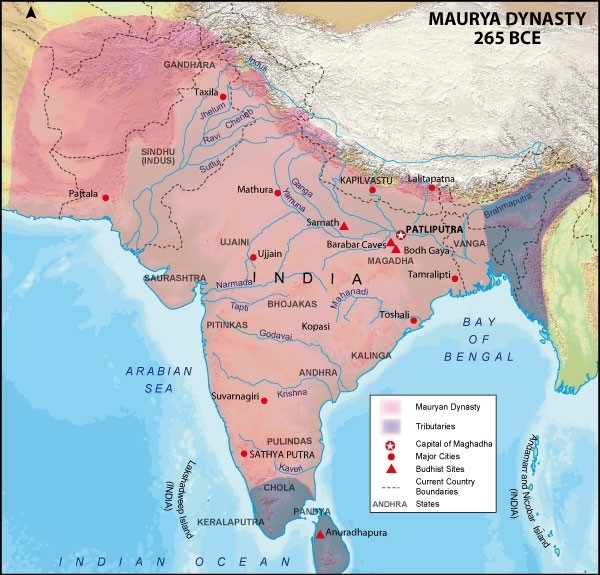
The Mauryan Empire started from Magadha was founded in 321 BC by Chandragupta Maurya. Mudrarakshasha written by Vishakadatta beautifully summarizes the rise of Chandragupta Maurya with the help of Chanakya. Chandragupta Maurya patronized Jainism.

Pataliputra, modern-day Patna was the capital city of Mauryan Empire.

Expansion of Mauryan Empire:-

Mauryan Empire was one of the world's largest empires of that time and expanded to an area of 5,000,000 km2. Leaving the parts of NE India, Kerala and Tamil Nadu, the Mauryans ruled over the rest of Indian Subcontinent.


Imperial Organization

Accounts of Megasthenes in his book Indika and the Arthashastra (written by Kautilya) describe the elaborate arrangements made in the Mauryan administration, society and economy.

The empire was divided into provinces which were under Princes. Along with this, a dozen departments, the armed forces containing six wings were also maintained. Chandragupta established a well-organized administrative system and gave it a sound financial base.

Bindusara (298-273 BC)

He was known to Greeks as Amitrochates and he patronized the Ajivika sect.

Ashoka:

Ashoka ascended the throne in 273BC and ruled up to 232 BC. He was known as ‘Devanampriya Priyadarsi’ the beautiful one who was the beloved of Gods.

Ashoka fought the Kalinga war in 261 BC. Kalinga is in modern Orissa.

Ashokan inscriptions were deciphered by James Princep.

After the battle of Kalinga, Ashoka became a Buddhist, being shocked by the horrors of the war, he replaced Bherighosha by Dhammaghosha

Ashoka was initiated to Buddhism by Upagupta or Nigrodha, a disciple of Buddha

For the propagation of Buddhism Ashoka started the institution of Dharmamahamatras.

Ashokan Inscriptions

Ashokan inscriptions carried royal orders through which he was able to speak directly to the people. There were rock edicts and pillar edicts which were again divided into major and minor.

The 14 Major Rock Edicts of Ashoka tell about the principles of Dharma

The Kalinga rock edict explains the principles of administration after Kalinga war. In his Kalinga edict, he mentions ‘‘All men are my children’’

The Major Rock Edict XII of Ashoka deals with the conquest of Kalinga.

The term ‘Ashoka’ was mentioned only in the Maski Minor rock edict.

Ashoka and Buddhism

Ashoka held the third Buddhist council at his capital Pataliputra in 250 BC under the presidentship of Moggaliputa Tissa.

He sent his son and daughter to Sri Lanka for the spread of Buddhism (Mahendra and Sanghamitra)

Ashoka spread Buddhism to SriLanka and Nepal. He is known as the Constantine of Buddhism.

Ceylon’s ruler Devanmpriya Tissa was Ashoka’s first convert to Buddhism.

The broad objective of Ashoka’s Dhamma policy was to preserve the social order.

Ashoka ruled for 40 years and died in 232 BC.

Mauryan Administration

Highly centralized administrative structure. Chanakya mentions the 7 elements of Saptanga theory in administration. The king is assisted by his Mantri Parishad. Important officials were appointed for various administrative activities.

The administration was divided in four units

The chakra or the province

The Ahar or the district

The Sangrahana or a group of villages

The Gram or village

The municipal administration headed by a Nagarak was also found in Arthashastra.

Mauryan Art

Royal Art – The Royal palaces, pillars, caves, stupas etc.

Popular art – Figure sculptures, Terracotta objects etc.

The emblem of the Indian Republic has been adopted from the four-lion capital of one of Ashokan pillars which is located in Sarnath. Another four-lion capital at Sanchi, Single lion capital at Rampurva and Lauria Nandangarh, single bull at Rampurva, carved elephant at Dhauli are found.

The Mauryas introduced Stone Masonry on large scale. They started the process of “hewing out” caves from rocks and construction of stupas to store the relics of Buddha and Bodhisattvas which in later stages were expanded by Guptas.

Reasons for the decline

Highly centralized Mauryan administration

Partition after the death of Ashoka disturbed the unity of the empire

Weak later Mauryan rulers were also a cause of the decline of the empire

Vedas and the Upanishads

The Vedic literature was composed in Sanskrit. To begin with the Vedas were recited and not written. They were taught by oral method. Hence they were called as Sruti (heard) and Smriti (memorized). But later on they were reduced to writing after the invention of scripts.

The major literary and religious works of Vedic Period are the four Vedas and the Upanishads. These works still continue to hold immense authority in the sphere of spiritual and religious literature. The idea and principles of Karma (action) and Moksha (spiritual liberation) are widely accepted by the people belonging to Hindu faith.

Four Vedas

Veda is a sanskrit word. It means “knowledge“. There were four Vedas :

The Rig Veda

The Sama Veda

The Yajur Veda and

The Atharva Veda.


1. The Rig Veda

Collection of hymns

Oldest of all vedas

Associated of 1017 hymns or Suktas after adding "Blhilya Sukta" number in 1028

Compiled in 10 'mandalas' & 8 'Akhtaks'.

Also contains the famous Gayatri Mantra

II, III, IV, V, VI & VII are oldest mandalas

I, VIII, IX, X are latest mandalas.

The Tenth "Mandalas" or chapter which has the "Purushasukta" hymn, was probably added later.

Mandala IX is completely devoted to 'Soma'.

Mandala II to VII was created by Grita Samada, Vishwamitra, Vamadeva, Atri, Bharadwaj, Vashistha, VIII Kanwa and Angira, IX Soma

2. Samveda

Rhthmic compilation of hymns for Rigveda

"Book for Chants" contains 1,549 hymns, meant to be sung at the 'soma' sacrifice by a special class of Brahmanas called Udgatris. But the Samaveda has very little original value.

Has only 75 fundamental hymns

3. The Yajur Veda

Book of sacrifical prayers

Rituals of yajnas

Is sung of priest "Adhavaryu"

Its mantras tell us how the sacrifices were to be performed and what part the "Adhvaryus"- the Brahmanas who performed the manual work in the arrangement of sacrifice were to play at the time of sacrifice.

Has been compiled in "fourth path"

Has been divided into, Krishna(black) Yajurveda & Shukla(white) Yajurveda

Prose text

4. Atharvaveda

Mantras for magic spells

Populate ritualistic system & superstitions

Associated with "Saunkiya" and "Paiplad" community

Collection of 711/731/760 hymns

Not included in 'Trai'

Has been divided in 20 "Kandas"

18th, 19th & 20th 'Kandas' are later works

Provides freedom from evils spirits.

Oldest text on Indian Medicine.


Vedic Literature and its History


The vast literature of the Aryans is divided into two parts -

Sruti

Smriti 

1. Sruti Literature: The word Veda has been divided from the Sanskrit word Ved, which means 'spiritual knowledge'. The Vedas are four in number - Rig Veda, Samaveda, Yajurveda, and Atharvaveda. The Rig Veda contains a references only to the first three Vedas, which suggests that the fourth Veda was composed at some later date.

The Vedic literature is usually divided into three periods:-

The Mantra period when the Samhitas were composed

Brahaman period when the Brahamanas, Upanishads and Aranyakas were composed

the Sutra period.

Brahmanas are massive prose text which contain speculation of the meaning of the hymns, give precepts for their application, relate stories of their origin in connection with sacrificial rites and explain the secret meaning of the later.

The Aranyakas are the concluding parts of the Brahamanas. It doest not lay much stress on rites, rituals and sacrifices, but merely contain the philosophy and mysticism. The lead with the problems of soul, origin and elements of universe and the creation of universe.

Aranyaka:-

Literarily, it means 'Jungle'

Provides the description of Moral Science and Philosophy

Provides details of hermits and saints who lived in Jungles

Give stress on meditation

Protests the system of 'Yajnas'

It would be appropriate to describe Upanishadas as mystic writings. There are 108 Upanishads in all, the most prominent of them being Ish, Prasana, Aitareya, Taittiriya, Chhandogaya, Kathoupanishad, Ishopanishad, Brehadaranyaka, etc.

Upanishada

Literary meaning is 'Satra' (to sit near masters feet) in which Guru offers band of knowledge to their disciples

Is a combination of Tatva-mimansa and philosophy

They are also called "Vedanta"

Primitive upanishada are "Brahadaranyaka" and "Chandogya"

Later Upnishada like "Katha" and "Swetaswatar" have been written in poetic forms.

Brahma is the summary of philosophy, which is the only a 'truth' in the world.

Knowledge awards salvation says Upanishadas

Oldest possibility Narsinghpurvatapani

Latest possibility Allopanishada in Akbar's reign

2. Smriti Literature: Smriti is traditional knowledge and designates almost the entire body of post-Vedic classical Sanskrit literature. Smriti literature generally includes the following overlapping subjects:-

The Vedangas: They refer to certain branches of post-Vedic studies regarded as auxiliary to the Vedas. The Vedangas are conventionally divided into six heading namely:-

(i)Kalpa or the ritual canon, including the dharma shastras or legal codes,

(ii)Jyotisha or astronomy,

(iii) Siksha or phonetics,

(iv)Chhanda or metre

(v) Nirukta or etymology

(vi)Vyakarana (Grammer)

The Shad-Darsana: Six orthodox schools of Hindu philosophy, namely Nyaya, 'Vaiseshikha', Sankhya, Yoga, Mimamsa and Vedanta.

Itihasa: Legendary or semi-legendary works, specifically the Ramayana and Mahabharata and often extended to the Puranas.

Puranas: Being a fairly late description of ancient legends, they are heavily coloured with the superstitions. The Puranas represent the most corrupt form of Hinduism. They are 18 in number

The Eighteen Puranas

Brahma Purana

Vishnu Purana

Shiva Purana

Padma Purana

Shrimad Bhagwat Purana

Agni Purana

Narad Purana

Markandey Purana

Bhavishya Purana

Ling Purana

Varah Purana

Vaman Purana

Brahm Vaivertya Purana

Shanda Purana

Surya Purana

Matsya Purana

Garuda Purana

Brahmand Purana

Upaveda: Also known as the auxiliary Vedas, they deal with medicine, architecture, erotics, archery and various arts and crafts. These were partly derived from original Vedic texts and were traditionally associated with one or other of the Vedas.

Tantras: Tantras are the writings of Shakta or Shaivite sects and also of certain antinomian Buddhist scholars

Agamas: They are scriptures of sectarian Hindus like Vaishnavites, Shaivites and Shaktas.

Upangas: They are a generic name for any collection of treatises although traditionally confined to the philosophical systems of 'Nyaya' and 'Mimansa' - the 'Dharma Sutras' the 'Puranas' and the 'Tantras'

Epics

Some historians regard the Later Vedic Period as the Period of Epics. The Mahabharata and the Ramayana are the two great epics of this period.
Ramayana: It is said to have been composed by the sage, Valmiki. The incident related in it precedes the Mahabharata by about a hundred and fifty years. The story of Ramayana is of indigenous origin and had existed in ballad form in Prakrit, in more than one version. It was rewritten in Sanskrit and augmented with many 'Shlokas'. The epic was given a Brahmanical character which was not visible in the original work. It is also known as Adi Kavya. Evidence places the oldest part of the Ramayana to before 350 BC. The reference in the epic to the mingled hords of Yavanas and Shakas suggests that it received accretions in the Graeco-Scythian period and may have acquired its final shape by about AD 250.

Mahabharata: The Mahabharata is the bulkiest epic consisting of 100,000 verses and is divided into 18 paravas (books). This book is usually assigned to Rishi Ved Vyas, but scholars have expressed doubts if such a great work could have been accomplished by one single person. The story itself occupies only about one-fourth of the poem. It is a tale about conflict between Aryans-Kaurava and Pandava.

The rest is episodical comprising cosmology, theogony, state craft, the science of war, ethics, legendary history, mythology, fairy tales and several digressional and philosophical interludes, of which the best known is the Bhagavad Gita.


Popular Posts

Featured post

Business Communication – Introduction Notes Business Communication is the ability of a group of individuals to speak the same langu...