Translate Your Page

Showing posts with label Constitution. Show all posts

Tuesday, January 08, 2019

Lengthy Constitution


Indian Constitution has 395 Articles and 12 Schedules. It was framed by a Constituent Assembly which was established for the purpose in 1946. The Constitution of India is the lengthiest constitution in the world as no other constitution contains as many articles. The constitution of USA has 7 Articles, China 138, Japanese 103 and Canadian 107 Articles.
India is a Sovereign, Socialist, Secular, Democratic and Republic State

The Constitution declares India to be a Sovereign, Socialist, Secular, Democratic, Republic.

Sovereign means absolutely independent, it is not under the control of any other state.

Socialist involves a system which will endeavour to avoid concentration of wealth in a few hands and will assure its equitable distribution. It also implies that India is against exploitation in all forms and believes in economic justice to all its citizens.

Secular means there is no state religion in India. Every citizen is free to follow and practice the religion of his/her own choice. The state cannot discriminate among its citizens on the basis of the religion.

Democratic means that the power of the government is vested in the hands of the people, people exercise this power through their elected representatives who are responsible to them. All citizens enjoy equal political rights.

Republic means that the head of the state is not a hereditary monarch.

Federal Government: The constitution provides for a federal form of government. In a federation, there are two governments- at the central level and at the state level. The powers of the government are divided between the central government and the state government.

Fundamental Rights & Fundamental Duties: Fundamental Rights and Fundamental Duties are most important characteristics of the Constitution. Fundamental Rights are considered to be essential for the proper moral and material uplift of people. These rights are fundamental in the sense that any law passed by the legislature in the country would be declared as null and void if it is derogatory to the rights guaranteed by the constitution.

Parliamentary Government: Indian Constitution provides a parliamentary form of government. President is the nominal head of the state. The government is run by the Prime Minister and other members of the Council of Minister. The Council of Ministers is collectively responsible to the Parliament.

Partly rigid and partly flexible: The Constitution of India is neither wholly rigid nor wholly flexible. It is partly rigid and partly flexible.

Certain provisions of the constitution can be amended by a simple majority in the Parliament.

Certain provisions can be amended by two-thirdsmajority of the Parliament and its ratification by at least fifty percent states.

The remaining provisions can be amended by the Parliament by the two-thirds majority.

Single Citizenship: In the federation, normally we have double citizenship. In U.S.A every citizen of United States of America is also a citizen of the state in which he or she resides. But the constitution of India provides single citizenship to every Indian.

Independent Judiciary: The Indian Constitution provides for an independent judiciary. The judiciary has been made independent of the Executive as well as the Legislature. The judges give impartial justice.


The President of India in the Indian Constitution


(1)Article 52 – There shall be a President of India
(2)Article 53 – Executive power of the Union: The executive power shall be vested in the President and shall be exercised by him either directly or through officers’ sub-ordinate to him.
(3)He is the supreme commander of the defence forces in India.
(4)Though he’s only the constitutional head, or titular head, de jure head or nominal executive or just a symbolic head.

Election of the President

1. The President shall be elected by the members of an ELECTORAL COLLEGE consisting of:

      (a)The ELECTED MPs
      (b)The ELECTED MLAs of the states
      (c)The ELECTED MLAs of National Capital territory of Delhi (added by 70th Amendment Act, 1992 and with effect from 1-06-1995) and Union territory of Puducherry.

2. Thus, nominated members of parliament and legislative assemblies and members of legislative councils do not participate in presidential election.
3. Article-55 provides for manner of election and there should be uniformity and representation throughout the Nation as per the constitution. Hence, MPs and MLAs have been assigned votes as per their representation.
4. Election is held in accordance with system of proportional representation by means of single transferable vote and voting is done by secret ballot.
5. All doubts and disputes arising out of the Presidential elections are decided into and enquired by the Supreme Court whose decision is final.
6. The elections are monitored and conducted by the Election Commission of India.
7. Only one President, that is, Neelam Sanjiva Reddy has been elected unopposed so far.
8. Dr. Rajendra Prasad is the only President to have been elected twice.
9. Two Presidents – Dr. Zakir Hussain and Fakhruddin Ali Ahmed have died in the office.

 Term of office (Article 56) and Re-election (Article 57)

Term – 5 years.

Resignation is addressed to the Vice-President.

The President is eligible for re-election for any number of terms.

Qualification (Article 58), Conditions (Article 59) & Oath (Article 60)

Eligibility -

      (a)citizen of India
      (b)35 years
      (c)Is eligible for election as an MP of the House of the People.

Shouldn’t hold any office of profit.

The President shall not be a member of either House of Parliament of any Legislature. Even if such a member is elected, he is deemed to have vacated that seat.

The nomination of a candidate for election must be subscribed by at least 50 electors as proposers and 50 electors as seconders.

Oath administered by the Chief Justice of India or in his absence the senior-most judge of the Supreme Court available.

Emoluments, allowances and privileges etc. as may be determined by the parliament and which can’t be diminished during his term.

He is immune from any criminal proceeding during his term. He can’t be arrested or imprisoned. However, after two-month’ notice civil proceedings can be initiated against him during his term in respect of his personal acts.

Impeachment of the President (Article 61)

A formal removal of the President from his post by constitutional means.

He is impeached for the ‘Violation of the Constitution’. However, the term is defined nowhere in the constitution.

The charges can be preferred by either house of the parliament. However, a 14-days’ notice shall be served to the President before the acceptance of such a resolution.

Also, that notice must be signed by at least one-fourth members of the total members of that house which initiated the charges.

After the acceptance of that bill in that house, that impeachment bill must be passed by the majority of 2/3rd of the total membership of that house.

Then that bill goes in another house which should investigate the charges and the President shall have the right to appear and to be represented at such an investigation.

If another house sustains the charges and finds the President of violation, and passes that resolution by 2/3rd of the total membership of that house, the President stands removed from the date the resolution is so passed.

Hence, impeachment is a quasi-judicial process. And though, the nominated members of Parliament do no participate in his election, they take part in the impeachment process. Also, states’ legislatures do not have a role in the impeachment process.

Powers of the President

Executive Powers

All executive actions are taken in his name. He is the formal, constitutional, titular head or de jure head of the Government.

Appoints the P.M and other ministers on P.M’s advice.

Appoints the Attorney General of India, CAG, Chief Election Commissioner and other Commissioners, the chairman and members of UPSC, Governors of states, Chairman and members of Finance Commission etc.

He appoints Inter-State Council and he is the one who can declare any area as scheduled area and decides on the matter of declaration of any tribe as scheduled tribe.

Legislative Powers

Summons and Prorogues the Parliament and dissolves the Lok Sabha.

Summons the joint sitting of the two houses of Parliament (which is presided over by the Speaker of Lok Sabha).

Nominates 12 members to Rajya Sabha from amongst people having achievements in art, literature, science and social service and may nominate 2 members to Lok Sabha from the Anglo-Indian Community.

His prior recommendation is required in case of presentation of certain types of bills such as money bills, bills seeking expenditure from the consolidated fund of India etc.

He can withhold his assent to bills, return the bills to the legislatures, apply pocket veto to bills etc.

He can promulgate ordinances when the parliament is not in session.

He lays the reports of Finance Commission, CAG, and UPSC etc. before the Parliament.

No demand for grant can be made except on his recommendation. Also, he constitutes a Finance Commission every five years for distribution of revenues between center and states.

Judicial Powers

Appoints the Chief Justice and other judges of the Supreme Court and High courts.

Seeks advice from the Supreme Court on any question of law.

He can grant pardon etc.

Emergency Powers

National Emergency (Article 352)

President’s Rule (Article 356)

Financial Emergency (Article 360)

Veto Powers

  The President of India has three types of Veto powers, namely

Absolute Veto- Withholding the assent to the bill. The bill then ends and does not become an act. Example- in 1954, Dr. Rajendra Prasad withheld his assent to the PEPSU Appropriation Bill. Also, in 1991 R. Venkataram withheld his assent to the MPs Salaries, allowances bill.

Suspensive Veto- Returning the bill for reconsideration. In 2006, President APJ Abdul Kalam used suspensive veto in office of profit bill. However, the President can return the bill for reconsideration to the legislature only once, after which he has to give his consent.

Pocket Veto- Taking no action on the bill sent to the President. There’s no time limit provided in the constitution within which the President has to give his assent or sign the bill. Hence, he has a ‘bigger pocket’ than the American President. In 1986, President Zail Singh applied Pocket Veto to Indian Post Office Amendment bill.

NOTE: The President has no veto power in case of a constitutional amendment bill. He is bound to give his assent to such bills.

Ordinance Making Powers (Article 123)

An ordinance can be issued by the President only when both houses of Parliament are not in session or when only one house is in session.

The ordinance must be approved by the Parliament within six weeks of its reassembly.

Hence, maximum life of an ordinance is – six months + six weeks.

He can issue an ordinance only on the advice of the council of ministers headed by the P.M

Pardoning power of the President (Article 72)

The President has the power to grant pardon, reprieve, commutation, remission, respite to any persons convicted in any Union Law, or by a court martial or in cases of death penalty.

It is an executive power. And the Governor also has those powers under Article 161, however, the Governor can’t pardon a death sentence nor can he interfere in court martial cases.

The President exercises this power on the advice of the Union Cabinet.

Discretionary Powers of the President

Appointment of the P.M when no party has a clear majority in the Lok Sabha or when the P.M in office dies suddenly and there’s no obvious successor.

Dismissal of the council of ministers when it can’t prove the confidence of the Lok Sabha.

Dissolution of the Lok Sabha if the council of ministers has lost its majority.

Use of Suspensive Veto in case of bills.

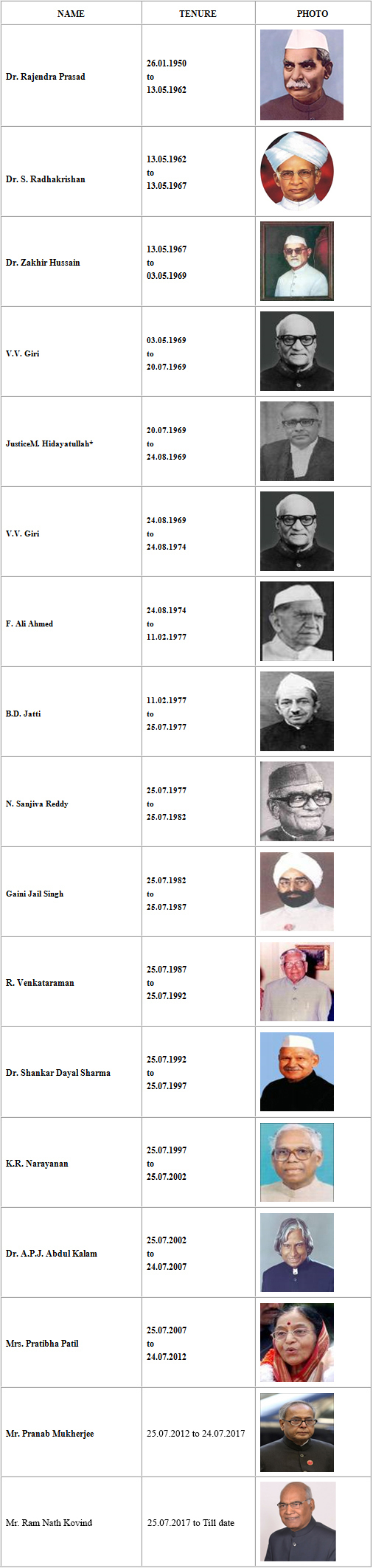
List of the Presidents of India


Important Constitutional Bodies


A constitutional body or an institution is the one which is specifically mentioned in the text of the constitution either originally or by virtue of some amendment, whereas a non-constitutional body is the one which isn’t mentioned in the text of the constitution.

ELECTION COMMISSION

Article 324 of the Constitution mentions about the election commission mentioned in part XV.

The institution of Election Commission presently consists of the chief election commissioner and two other election commissioners, appointed by the President.

They hold office for a term of six years. The age of retirement is 65 years, whichever comes earlier.

The first election commissioner of India was Sukumar Sen.

UNION PUBLIC SERVICE COMMISSION

Mentioned under articles 315 to 323 in Part XIV of the Constitution (Article 315 mentions about the public service commission for the union and the states).

The UPSC consists of a chairman and other members appointed by the president of India.

The term is of six years or the retirement age is 65 years, whichever is earlier.

The chairman of UPSC (on ceasing to hold office) is not eligible for further employment in the Government of India or a state.

STATE PUBLIC SERVICE COMMISSION

A State Public Service Commission consists of a chairman and other members appointed by the governor of the state.

The term of office is 6 years or retirement age is 62 years, whichever is attained earlier. They offer their respective resignations to the governor.

The chairman and members can be removed only by the President, though they’re appointed by the Governor. The ground for removal is same as that of a chairman or a member of the UPSC.

NOTE – There is a provision for the establishment of a Joint Public Service Commission (JPSC) for two or more states under the constitution.

JPSC is/can be created by an act of parliament on the request of the respective states, unlike UPSC and SPSC which are constitutional bodies. Hence, a JPSC is a statutory body not a constitutional one.

The chairman and members of a JSPSC are appointed by the president. The term of office is again six years or the age of retirement is 62 years, whichever comes earlier.

FINANCE COMMISSION

Article 280 of the Constitution of India provides for a Finance Commission. It is constituted by the president of India every fifth year or at such earlier time as he considers necessary.

The Finance Commission consists of a chairman and four other members to be appointed by the president. They hold office for such period as specified by the president in his order. They are eligible for reappointment.

It is majorly an advisory body though and it advises on the distribution of net proceeds of taxes to be shared between the centre and the states and the allocation between the states the respective shares of such proceeds.

The Chairman of the first finance commission was K.C Neogi and presently it is the 14th F.C whose chairman is Y.V Reddy.

NATIONAL COMMISSION FOR SCs

Mentioned in the Article 338 of the Constitution of India.

NATIONAL COMMISSION FOR STs

Mentioned in the Article 338-A of the Constitution of India.

SPECIAL OFFICER FOR LINGUISTIC MINORITIES

It is mentioned in 350-B in Part XVII of the Constitution.

COMPTROLLER and AUDITOR GENERAL of INDIA

The Constitution of India (Article 148) provides for an independent office of the Comptroller and Auditor General of India (CAG).

He is the head of the Indian Audit and Accounts Department.

He is the guardian of the public purse and controls the entire financial system of the country at both the levels—the Centre and the state.

This is the reason why Dr B R Ambedkar said that the CAG shall be the most important Officer under the Constitution of India.

The CAG is appointed by the president of India by a warrant under his hand and seal.

He holds office for a period of six years or up to the age of 65 years, whichever is earlier.

He can be removed by the President either on the grounds of proven misbehaviour or incapacity. The method of removal is same as that of a judge of the Supreme Court.

He is not entitled to hold any further employment after he retires or is removed, either at the centre or at the state government level.

The administrative expenses of the office of the CAG, including all salaries, allowances and pensions of persons serving in that office are charged upon the Consolidated Fund of India. Thus, they are not subject to the vote of Parliament.

He audits the accounts related to all expenditure from the Consolidated Fund of India, consolidated fund of each state and consolidated fund of each union territory having a Legislative Assembly.

He audits all expenditure from the Contingency Fund of India and the Public Account of India as well as the contingency fund of each state and the public account of each state.

He submits his audit reports relating to the accounts of the Centre to President, who shall, in turn, place them before both the Houses of Parliament (Article 151).

He submits his audit reports relating to the accounts of a state to the governor, who shall, in turn, place them before the state legislature (Article 151).

The President lays the reports submitted by CAG before both the Houses of Parliament. The Public Accounts Committee then scrutinizes them and reports the findings to the Parliament.

ATTORNEY GENERAL OF INDIA

Mentioned in the Article 76 of the Constitution of India.

Titled as the highest law officer in the country.

Appointed by the President.

An AGI is one who is qualified to be appointed a judge of the Supreme Court.

The term is not fixed and he holds office during the pleasure of the President.

In the performance of his official duties, the Attorney General has the right of audience in all courts in the territory of India. Further, he has the right to speak and to take part in the proceedings of both the Houses of Parliament or their joint sitting and any committee of the Parliament of which he may be named a member, but without a right to vote. He enjoys all the privileges and immunities that are available to a Member of Parliament.

NOTE- In addition to the AG, there are other law officers of the Government of India. They are the solicitor general of India and additional solicitor general of India. They assist the AG in the fulfilment of his official responsibilities. It should be noted here that only the office of the AG is created by the Constitution. In other words, Article 76 does not mention about the solicitor general and additional solicitor general.

The first and the longest serving AGI of India was Motilal Chimanlal Setalvad.

ADVOCATE GENERAL OF THE STATE

The Constitution (Article 165) has provided for the office of the advocate general for the states. He is the highest law officer in the state. Thus he corresponds to the Attorney General of India.

The advocate general is appointed by the governor. He must be a person who is qualified to be appointed a judge of a high court.


THE PANCHAYATI RAJ INSTITUTIONS


THE PANCHAYATS

The local self-government at the grass-root levels signifies the Panchayati Raj institutions.

They were constitutionalized by 73rd and 74thconstitutional amendment acts 1992 respectively.

In January 1957, the Government of India appointed a committee to examine the working of the Community Development Programme (1952) and the National Extension Service (1953) and to suggest measures for their better working. The chairman of this committee was Balwant Rai G Mehta. It was as per the recommendations of this committee that Panchayati Raj Institutions came up in India post-independence.

Rajasthan was the first state to establish Panchayati Raj. The scheme was inaugurated by the prime minister on October 2, 1959, in Nagaur district. Next was Andhra Pradesh, which too adopted the system in 1959. Gradually, more states followed.

In December 1977, the Janata Government appointed a committee on Panchayati Raj institutions under the chairmanship of Ashok Mehta to revive and strengthen the declining PRIs in India.

The Committee on Administrative Arrangement for Rural Development and Poverty Alleviation Programmes under the chairmanship of G.V.K. Rao was appointed by the Planning Commission in 1985.

In 1986, Rajiv Gandhi government appointed a committee on ‘Revitalisation of Panchayati Raj Institutions for Democracy and Development’ under the chairmanship of L M Singhvi.

The 73rd constitutional amendment act 1992 has added a new Part-IX to the Constitution of India titled ‘The Panchayats’ and consists of provisions from Articles 243 to 243 O. In addition, the act has also added a new Eleventh Schedule to the Constitution. This schedule contains 29 functional items of the panchayats. It deals with Article 243-G.

The Amendment created a constitutional institution known as Gram Sabha, which is a body at the village level comprising of all the registered voters in the village within the area of the Panchayat.

The 73rd CAA provides for the three-tier system of PRIs in every state- village, intermediate and district levels.

The members of panchayat shall be directly elected by the people. Further, the chairperson of panchayats at the intermediate and district levels shall be elected indirectly—by and from amongst the elected members thereof. However, the chairperson of a panchayat at the village level shall be elected in such manner as the state legislature determines.

The normal term of the Panchayat at every level shall be five years. The dissolution can also take place before the expiry of the term of the Panchayat. Fresh elections must be held before the expiry of the incumbent Panchayat and if there’s dissolution, then before the expiration of 6 months.

The superintendence, direction, and control of the preparation of electoral rolls and the conduct of all elections to the Panchayats shall be vested in the state election commission.

The minimum age to contest elections at the panchayat level is 21 years.

Some states where this act does not apply in totality – J&K, Mizoram, Meghalaya and Nagaland and some other scheduled and tribal areas.

The act came into effect from 24th April 1993 and added new parts – part ninth and ninth-A; and new schedules- 11th and 12th to the constitution of India.

THE MUNICIPALITIES

The term ‘Urban Local Government’ in India signifies the governance of an urban area by the people through their elected representatives. The jurisdiction of an urban local government is limited to a specific urban area which is demarcated for this purpose by the state government.

The system of urban government was constitutionalized through the 74th Constitutional Amendment Act of 1992. It added a new part – part 9th-A; and a new schedule- schedule 12th to the constitution of India. There are eight types of urban local governments in India in totality.

In 1687-88, the first municipal corporation in India was set up at Madras.

In 1726, the municipal corporations were set up in Bombay and Calcutta.

Lord Ripon is regarded as the father of local-self-government in India. His resolution of 1882 is considered as the ‘Magna Carta’ of local self-rule in this regard.

NOTE – The part 9th B was added by 97thconstitutional amendment act, 2012 and provides constitutional status to the co-operative societies.

CENTRE-STATE RELATIONS

Articles 245 to 255 in Part XI of the Constitution deal with the legislative relations between the Centre and the states.

The constitution mentions about three types of Lists.

(a) Union List
(b) State List
(c) Concurrent List

The Union List mentions about those subjects on which only the Union Parliament can legislate.

The State list mentions about those subjects on which only the states in India ‘under normal circumstances’ can legislate.

The Concurrent list mentions about those subjects on which both the Union as well as the States can legislate.

The Union list contains 100 subjects presently (originally 97 subjects).

Examples of subjects in Union list - defense, banking, foreign affairs, currency, atomic energy, insurance, communication, inter-state trade and commerce, census, audit and so on.

The State contains 61 subjects presently (originally 66 subjects).

Examples of subjects in State list - public order, police, public health and sanitation, agriculture, prisons, local government, fisheries, markets, theatres, gambling and so on.

The Concurrent list contains 52 subjects presently (originally 47 subjects).

Examples of subjects in a Concurrent list - criminal law and procedure, civil procedure, marriage and divorce, population control and family planning, electricity, labor welfare, economic and social planning, drugs, newspapers, books and printing press, and others.

However, if the Rajya Sabha declares that it is necessary in the national interest that Parliament should make laws on a matter in the State List, then the Parliament becomes competent to make laws on that matter. Such a resolution must be supported by two-thirds of the members present and voting. The resolution remains in force for one year; it can be renewed any number of times but not exceeding one year at a time (Article 249).

Also, the Parliament acquires the power to legislate with respect to matters in the State List, while a proclamation of national emergency is in operation (Article 250).

Furthermore, when the legislatures of two or more states pass resolutions requesting the Parliament to enact laws on a matter in the State List, then the Parliament can make laws for regulating that matter. A law so enacted applies only to those states which have passed the resolutions. However, any other state may adopt it afterward by passing a resolution to that effect in its legislature. Such a law can be amended or repealed only by the Parliament and not by the legislatures of the concerned states (Article 252).

The Parliament can make laws on any matter in the State List for implementing the international treaties, agreements or conventions (Article 253).

Note – Parliament has the exclusive power to legislate on any matter not mentioned in either the State list or Concurrent list (Article 248) – Residuary powers of legislation.

Sarkaria Commission, Rjamannar Commission and Punchhi Commission are some important commissions related to the Centre-State Relations.


GOVERNOR, CHIEF MINISTER, STATE COUNCIL OF MINISTERS and STATE LEGISLATURE


THE GOVERNOR

The Governor is the De Jure executive head at the state level. His position is analogous to that of the President at the centre.

The Governor is appointed by the president.

To be appointed as the Governor of any state or two or more states as person
(a) Should be a citizen of India.
(b) And should have attained 35 years of age.

He should not hold any office of profit as well.

Like the President, the governor is also entitled to a number of immunities and privileges. During his term of office, he is immune from any criminal proceedings, even in respect of his personal acts.

The oath - is administered by the chief justice of the corresponding state high court and in case he’s absent, the senior-most judge of that particular court.

A governor holds office for a term of five years from the date on which he enters upon his office. He holds office until the pleasure of the President and he offers his resignation to the President.

All executive actions of the government of a state are formally taken in his name. He appoints the chief minister and other ministers. They also hold office during his pleasure.

He appoints the advocate general of a state and determines his remuneration. The advocate general holds office during the pleasure of the governor.

He appoints the state election commissioner. However, the state election commissioner can be removed only in like manner and on the like grounds as a judge of a high court.

He appoints the chairman and members of the state public service commission. However, they can be removed only by the president and not by a governor.

A governor is an integral part of the state legislature. He can summon or prorogue the state legislature and dissolve the state legislative assembly.

He nominates one-sixth of the members of the state legislative council.

He can nominate one member to the state legislature assembly from the Anglo-Indian Community.

The Governor can withhold the assent to bills, return the bills for reconsideration (if they’re not money bills), and even reserve the bills for consideration by the President. (He can even reserve a money bill for consideration by the President).

He can promulgate ordinances when the state legislature is not in session. The ordinances must be approved by the state legislature within six weeks from its reassembly. He can also withdraw an ordinance anytime (Article 213).

Money bills can be introduced in the state legislature only with his prior recommendation.

He can grant pardons, reprieves, respites and remissions of punishment or suspend, remit and commute the sentence of any person convicted of any offence against any law relating to a matter to which the executive power of the state extends (Article 161).

He is consulted by the president while appointing the judges of the concerned state high court.

Important Articles

153 - Governors of states

154 - Executive power of state

155 - Appointment of Governor

156 - Term of office of Governor

157 - Qualifications for the appointment as the Governor

158 - Conditions of the Governor’s office

159 – Governor’s Oath or Affirmation

161 - Power of the Governor to grant pardons and others

163 – Aid and Advice by the Council of Ministers to the Governor

165 - Advocate-General for the state

200 - Assent to bills (i.e. assent of the Governor to the bills passed by the state legislature)

201 - Bills reserved by the Governor for consideration of the President

213 – Governor’s power to promulgate ordinances

217 – Consultation of Governor by the President in the matter of the appointments of the judges of the High Courts

THE CHIEF MINISTER AND THE STATE COUNCIL OF MINISTERS

Chief Minister is the real executive authority (de facto executive). He is the head of the government.

The total strength of the number of ministers, including the C.M, in the state’s CoM should not exceed 15 per cent of the total strength of the legislative assembly of that state. However, the number of ministers, including the C.M, in a state should also not be less than 12. This provision was added by the 91st Amendment Act of 2003.

A member of either House of state legislature belonging to any political party who is disqualified on the ground of defection shall also be disqualified to be appointed as a minister. The provision was also added by the 91st Amendment Act of 2003.

THE STATE LEGISLATURE

Organization of the State Legislature

Most of the states in India have a Unicameral Legislature. Seven States have Bicameral Legislature, that is-Telangana, Andhra Pradesh, Maharashtra, Bihar, U.P, J&K and Karnataka.

The Legislative Council (Vidhan Parishad) is the upper house (second chamber or house of elders), while the Legislative Assembly (Vidhan Sabha) is the lower house (first chamber or popular house). Delhi and Puducherry are the only two UTs that have a Legislative Assembly.

Composition of the State Legislature

The legislative assembly consists of representatives directly elected by the people on the basis of universal adult franchise. Its maximum strength is fixed at 500 and minimum strength at 60 depending on the population size of the state. However, in case of Sikkim it is 32; and Goa and Mizoram it’s 40.

The members of the legislative council are indirectly elected. Maximum strength of the legislative council is fixed at 1/3rd of the total strength of the corresponding assembly and the minimum strength is fixed at 40. But an exception being Jammu and Kashmir having 36 members.

Manner of Election Of the total number of members of a legislative council:
(a) 1/3 are elected by the members of local bodies in the state such as municipalities etc.,
(b) 1/12 are elected by graduates of three years standing and residing within the state,
(c) 1/12 are elected by teachers of three years standing in the state, not lower in standard than secondary school,
(d) 1/3 are elected by the members of the legislative assembly of the state from amongst persons who are not members of the assembly, and
(e) The remainder are nominated by the governor from amongst the persons who have a special knowledge or practical experience of literature, science, art, cooperative movement and social service.

Thus, 5/6 of the total number of members of a legislative council is indirectly elected and 1/6 are nominated by the governor. The members are elected in accordance with the system of proportional representation by means of a single transferable vote.

Duration of the two Houses

Analogous to the Lok Sabha, the legislative assembly is also not a permanent chamber. Term of the assembly is five years from the date of its first meeting after the general elections.

Analogous to the Rajya Sabha, the legislative council is a continuing chamber, that is, it is a permanent body and is not subject to dissolution. But, one-third of its members retire on the expiration of every second year.

Membership of the State Legislature

The Constitution lays down the following qualifications for a person to be chosen a member of the State legislature.
(a) Citizen of India.
(b) He must be not less than 30 years of age in the case of the legislative council and not less than 25 years of age in the case of the legislative assembly.

He should not have been found guilty as per the provisions of RPA, 1951. In defection case also a member is liable to be disqualified as per Anti-Defection Act (10TH Schedule).

Also, he should not be of unsound mind, he should not hold any office of profit; he isn’t declared an un-discharged insolvent etc.

Presiding Officers of State Legislature

Each House of the state legislature has its own presiding officer. There is a Speaker and a Deputy Speaker for the legislative assembly and Chairman and a Deputy Chairman for the legislative council. A panel of chairmen for the assembly and a panel of vice-chairmen for the council are also appointed.

The Speaker is elected by the assembly itself from amongst its members.

Like the Speaker, the Deputy Speaker is also elected by the assembly itself from amongst its members. He is elected after the election of the Speaker has taken place.

The Chairman is elected by the council itself from amongst its members.

The Speaker decides whether a bill is a Money Bill or not and his decision on this question is final.

Important points related to the State Legislature

The maximum gap between the two sessions of state legislature cannot be more than six months, that is, the state legislature should meet at least twice a year.

Quorum is the minimum number of members required to be present in the House before it can transact any business. Either its 10 or 1/10th of the total number of members in that particular House (including the presiding officer).

In addition to the members of a House, every minister and the advocate general of the state have the right to speak and take part in the proceedings of either House or any of its committees of which he is named a member, but Advocate General can’t vote.

A Money Bill cannot be introduced in the legislative council. It can be introduced in the legislative assembly only and that too on the recommendation of the governor. Every such bill is considered to be a government bill and can be introduced only by a minister.


The Vice- President of India in the Indian Constitution


The Vice-President of India (Important Articles covered: 63-71)

Part V of the Constitution of India under Chapter I (Executive) also discusses the office of the Vice-President of India. The Vice-President of India is the second highest constitutional office in the country.

Article 63: The Vice-President of India

There shall be a Vice-President of India.

This article mentions about the CONSTITUTIONAL OFFICE of the VICE-PRESIDENT of India.

As we shall see subsequently that the post was created to maintain a continuum in the hierarchy in Indian political system. The V.P does not have very major functions or powers as such.

The post has been inspired by the Constitution of the U.S(QUESTION HAS BEEN ASKED)

Article 64: The Vice-President is to be an ex-officio Chairman of the Council of States.

The Vice-President shall be ex-officio Chairman of the Council of States and shall not hold any other office of profit:

This is probably the most important function of the V.P. Ex-officio means by VIRTUE OF HOLDING THE OFFICE. That is,a person automatically becomes THE CHAIRPERSON OF RAJYA SABHA (COUNCIL OF STATES) if he/she is ELECTED as the Vice-President of India.

The first Chairperson of the Rajya Sabha - Dr. Sarvepalli Radhakrishnan

Provided that during any period when the Vice-President acts as President or discharges the functions of the President under article 65, he shall not perform the duties of the office of Chairman of the Council of States and shall not be entitled to any salary or allowance payable to the Chairman of the Council of States under article 97.

This is the second most important function of the V.P. He can act as the President in case of the death, impeachment, resignation or otherwise of the President of India. However he can act as the president only for a maximum period of six months (question asked) within which a new president has to be elected.

Important Points

When the President Dr.Zakir Hussain died in office, the then Vice-President V.V.Giri acted as the President.

When the President Fakruddin Ali Ahmed died in office, the then Vice-President B.D.Jatti acted as the president.

The Vice-President Dr.S. Radhakrishnan discharged the duties of the President in June 1960 when the then President Dr. Rajendra Prasad was on a 15-day tour to the former USSR. Also, again in July 1961 he discharged the functions of the President when Dr. Rajendra Prasad was very ill.

The V.P gets the salary, allowance and remuneration etc. as the chairperson of the Rjaya Sabha. The present salary of the V.P is 1,25,000 per month.

As has been mentioned above, the V.P gets the salary, allowance etc. of the President when he acts as the president not as the chairperson of the Rajya sabha.

The salary, emoluments etc. of the chairperson of the Rajya Sabha is mentioned in the second schedule of the Constitution of India.

Article 65: The Vice-President to act as President or to discharge his functions during casual vacancies in the office, or during the absence of President.

As has already been mentioned above, the V.P shall act as the President in case of the President’s death, resignation, removal or otherwise.

Article 66: Election of Vice-President

Vice‑President is elected by members of an electoral college consisting of the members of both the Houses of the Parliament. However, his election is different from that of the President as the state legislatures have no part in it.

The election is held in accordance with the system of proportional representation and voting is done by the secret ballot.

The V.P shall not be a member of either house of parliament or any state legislature, if that is the case then that person is deemed to have vacated the M.P’s or M.L.A’s or M.L.C’s post on the date on which he become the Vice-President.

Eligibility Criteria for Vice - President

He/She should be citizen of India

He/She has completed the age of 35 years.

He/She should be qualified for the member of Rajya Sabha

Does not hold any office of profit under union, state or local authority.

However, for this purpose, the President, Vice‑President, Governor of a State and a Minister of the Union or a State, are not held to be holding an office of profit. (An office of profit is any office that would give its occupant the opportunity to gain a financial advantage or benefit).

 Important Points

The Election Commission of India conducts the election to the office of the Vice-President.

The election of the next Vice-President is to be held within 60 days of the expiry of the term of office of the outgoing Vice-President.

Any person qualified to be elected and intending to stand for election as Vice-President is required to be nominated by at least 20 MPs as proposers and at least 20 MPs as seconders.

A candidate seeking election as Vice-President is required to make a security deposit of Rs.15,000/-.

All doubts and disputes arising in connection with the election of the Vice-President are enquired into and decided by the Supreme Court of India whose decision is final.(Art.71)

Article 67: Term of office of Vice-President

The Vice-President shall hold office for a term of five years from the date on which he enters upon his office:

Provided that –

(a) A Vice-President may, by writing under his hand addressed to the President, resign his office;

(b) a Vice-President may be removed from his office by a resolution of the Council of States passed by a majority of all the then members of the Council and agreed to by the House of the People; but no resolution for the purpose of this clause shall be moved unless at least fourteen days’ notice has been given of the intention to move the resolution;

(c) A Vice-President shall, notwithstanding the expiration of his term, continue to hold office until his successor enters upon his office.

Article 68: Time of holding election to fill vacancy in the office of Vice-President and the term of office of person elected to fill casual vacancy.

The election must be held before the completion of the incumbent Vice-President. Also see Note 2 under Article 66.

Article 69Oath or affirmation by the Vice-President

Every Vice-President shall, before entering upon his office, make and subscribe before the President, or some person appointed in that behalf by him, an oath or affirmation in the following form, that is to say – “I, A.B., do swear in the name of God /solemnly affirm that I will bear true faith and allegiance to the Constitution of India as by law established and that I will discharge the duty upon which I am about to enter.”

Article 70: Discharge of President’s functions in other contingencies.


Article 71:Matters relating to, or connected with, the election of a President or Vice-President.

See Note – 6 Under Article 66

The Parliament is empowered to make laws related to such provisions of the Presidential and Vice-Presidential matters such as elections, terms, and so on.

A few other important points about the V.P of India

S. Radhakrishnan was the first V.P of India and he held the post twice from 1952-1957 and then from 1957-1962. Md. Hamid Ansari has replicated that i.e. from 2007-2012 and from 2012- continuing.

Shri Krishan Kant was the only V.P to have died in office.

The V.P.s who went on to become the Presidents – Dr. S. Radhakrishnan, Zakir Hussain, V.V. Giri, R. Venkataraman, S.D. Sharma, K.R. Narayanan.

Because of the limited powers and functions the V.P of India is also at times termed as “HIS SUPERFLUOUS HIGHNESS

List of Vice-President of India

Name of Vice President
Office Period
Sarvepalli Radhakrishnan
1952-1962
Zakir Husain
1962-1967
Varahagiri Venkata Giri
1967-1969
Gopal Swarup Pathak
1969-1974
Basappa Danappa Jatti
1974-1979
Mohammad Hidayatullah
1979-1984
Ramaswamy Venkataraman
1984-1987
Shankar Dayal Sharma
1987-1992
Kocheril Raman Narayanan
1992-1997
Krishan Kant
1997-2002
Bhairon Singh Shekhawat
2002-2007
Mohammad Hamid Ansari
2007-2017
Muppavarapu Venkaiah Naidu
2017- till date


Summary of the Making of the Indian Constitution


It was M.N Roy who proposed the idea of an independent constituent assembly for India in 1934.

The constituent assembly was formed as per the guidelines suggested by the Cabinet Mission Plan, 1946. The mission was headed by Pethick Lawrenceand included two other members apart from him – Stafford Cripps and A.V Alexander.

The total strength of the assembly was 389. However, after partition only 299 remained. It was partly elected and partly nominated body.

The elections to form the assembly took place in July-August 1946 and the process was completed by November 1946. The first meeting of the assembly took place on 9th December 1946 and was attended by 211 members.

Dr. Sachhidanand Sinha became the temporary President of the assembly following the French practice.

On 11th December 1946, Dr. Rajendra Prasad and H.C Mukherji were elected as President and Vice-President respectively.

Sir B.N Rau was appointed as the constitutional advisor to the assembly.

On 13th December 1946, Pt. Nehru moved the Objectives resolution which later went on to become the Preamble of the constitution in slightly modified form. The resolution was unanimously adopted on 22nd January 1947.

The Constituent Assembly ratified India’s membership of the commonwealth in May 1949. Also, it adopted National Song and National Anthem on 24th January 1950. Adopted the National Flag on 22nd July 1947.

The assembly met for 11 sessions, took 2 years, 11 months and 18 days to frame up the final draft, sat for 141 days in total and the draft constitution was considered for 114 days. Total amount incurred was around rupees 64 lakhs.

The assembly had 15 women members which were reduced to 9 after partition.

Some important committees of the constituent assembly along with their respective chairpersons are as follows:

Union Powers Committee - Jawahar Lal Nehru

Union Constitution Committee - Jawahar Lal Nehru

Provincial Constitution Committee - Sardar Patel

Drafting Committee - B.R Ambedkar

Rules of Procedure Committee - Dr. Rajendra Prasad

Steering Committee - Dr. Rajendra Prasad

Flag Committee - J.B. Kripalani

The following were the members of the Drafting Committee

Dr. B.R Ambedkar (Chairman)

Alladi Krishnaswamy Ayyar

Dr. K.M Munshi

N. Gopalaswamy Ayyangar

Syed Mohammad Saadullah

N Madhava Rau

TT Krishnamachari

The final draft of the constitution was adopted on 26th November 1949 and it contained 8 schedules, 22 parts, and 395 articles.

VARIOUS SOURCES OF THE INDIAN CONSTITUTION

Government of India Act of 1935 - Federal Scheme, Office of the governor, Judiciary, Public Service Commissions, Emergency provisions and administrative details.

British Constitution - Parliamentary government, Rule of Law, legislative procedure, single citizenship, cabinet system, prerogative writs, parliamentary privileges, and bicameralism.

US Constitution - Fundamental rights, independence of the judiciary, judicial review, impeachment of the president, removal of Supreme Court and high court judges and post of vice-president.

Irish Constitution - Directive Principles of State Policy, nomination of members to Rajya Sabha and method of election of the president.

Canadian Constitution - Federation with a strong Centre, vesting of residuary powers in the Centre, the appointment of state governors by the Centre, and advisory jurisdiction of the Supreme Court.

Australian Constitution - Concurrent List, freedom of trade, commerce and intercourse, and the joint sitting of the two Houses of Parliament.

Weimar Constitution of Germany - Suspension of Fundamental Rights during Emergency.

Soviet Constitution (USSR, now Russia) - Fundamental duties and the idea of justice (social, economic and political) in the Preamble.

French Constitution - Republic and the ideals of liberty, equality, and fraternity in the Preamble.

South African Constitution - Procedure for amendment of the Constitution and election of members of Rajya Sabha.

Japanese Constitution - Procedure established by Law.


THE PARLIAMENT (ARTICLES 79-122)


The Organization of the Parliament

The Parliament consists of the President, the Lok Sabha and the Rajya Sabha.

Lok Sabha is the Lower House (First Chamber or Popular House) and Rajya Sabha is the Upper House (Second Chamber or House of Elders).

The Composition of Rajya Sabha

The maximum strength of the Rajya Sabha is fixed at 250, out of which, 238 are to be the representatives of the states and union territories (elected indirectly) and 12 are nominated by the president.

At present, the Rajya Sabha has 245 members. Of these, 229 members represent the states, 4 members represent the union territories and 12 members are nominated by the president.

The Fourth Schedule of the Constitution deals with the allocation of seats in the Rajya Sabha to the states and union territories.

The representatives of states in the Rajya Sabha are elected by the elected members of state legislative assemblies. The seats are allotted to the states in the Rajya Sabha on the basis of population.

The Composition of Lok Sabha

The maximum strength of the Lok Sabha is fixed at 552. Out of this, 530 members are to be the representatives of the states, 20 members are to be the representatives of the union territories and 2 members may be nominated by the president from the Anglo-Indian community.

At present, the Lok Sabha has 545 members.

The representatives of states in the Lok Sabha are directly elected by the people from their respective constituencies.

The voting age was reduced from 21 to 18 years by the 61st Constitutional Amendment Act, 1988.

Duration of the two Houses of Parliament

The Rajya Sabha is a permanent body and not subject to dissolution. However, one-third of its members retire every second year. The retiring members are eligible for re-election and re-nomination any number of times.

Unlike the Rajya Sabha, the Lok Sabha is not a continuing chamber. Its normal term is five years from the date of its first meeting after the general elections, after which it automatically dissolves.

Qualification, disqualifications etc. to be an MP

Eligibility

      (a) Citizen of India.
      (b) Minimum age – 30 years in Rajya Sabha and 25 years in Lok Sabha.
      (c) He must possess other qualifications prescribed by Parliament. (Hence, the Representation of People Act, 1951).

For being disqualified for being elected as an MP:

      (a) If he holds any office of profit under the Union or state government
      (b) If he is of unsound mind and stands so declared by a court.
      (c) If he is an undischarged insolvent.
      (d) if he is not a citizen of India or has voluntarily acquired the citizenship of a foreign state or is under any acknowledgement of allegiance to a foreign state; and
      (e) If he is so disqualified under any law made by Parliament (RPA, 1951).

The Constitution also lays down that a person shall be disqualified from being a member of Parliament if he is so disqualified on the ground of defection under the provisions of the Tenth Schedule.

Double Membership - A person cannot be a member of both Houses of Parliament at the same time.

A House can declare the seat of a member vacant if he is absent from all its meetings for a period of sixty days without its permission.

The Speaker of the Lok Sabha

The Speaker is elected by the Lok Sabha from amongst its members (as soon as may be, after its first sitting). The date of election of the Speaker is fixed by the President.

The Speaker offers his resignation to the Deputy Speaker and he can be removed by a resolution passed by a majority of members of Lok Sabha, however, only after giving him a 14-day notice.

He presides over a joint sitting of the two Houses of Parliament. Such a sitting is summoned by the President to settle a deadlock between the two Houses on a bill.

He decides whether a bill is a money bill or not and his decision on this question is final.

He can’t vote in the first instance, though can vote in the event of a tie. When his removal motion is under consideration, he can take part and speak in the proceedings and can vote as well but not in the case of a tie. He can’t preside in that case. However, his motion can be passed by an absolute majority only and can be considered only if it has the support of at least 50 members.

G.V Mavalankar was the first Speaker of Lok Sabha.

The longest serving Speaker of Lok Sabha so far has been Balram Jakhar.

NOTE – There’s also a post known as Speaker Pro Tem, appointed by the President himself. He is usually the oldest member of the last Lok Sabha and he presides over the first session of the incoming Lok Sabha. President administers him the oath.

The Deputy Speaker of the Lok Sabha

Like the Speaker, the Deputy Speaker is also elected by the Lok Sabha itself from amongst its members.

The date of election of the Deputy Speaker is fixed by the Speaker. The removal process is same as that of a speaker and he offers his resignation to the Speaker of the Lok Sabha.

Madabhushi Ananthasayanam Ayyangar was the first Deputy Speaker of Lok Sabha.

He presides over the joint sitting in case of absence of the Speaker.

Sessions of Parliament

A ‘session’ of Parliament is the period spanning between the first sitting of a House and its prorogation (or dissolution in the case of the Lok Sabha). The time period between the prorogation of a House and its reassembly in a new session is called ‘Recess’. There are usually three sessions. The budget session is the longest and winter is the shortest.

The Budget Session (February to May);

The Monsoon Session (July to September); and

The Winter Session (November to December).

Important parliamentary terms, points, motions, bills, questions and Committees

The maximum gap between two sessions of Parliament cannot be more than six months.

The President summons and prorogues the two houses of parliament.

Quorum is the minimum number of members required to be present in the House before transaction of any business. It is one-tenth of the total number of members in each House including the presiding officer. It means that there must be at least 55 members present in the Lok Sabha and 25 in the Rajya Sabha.

Every minister and the attorney general of India have the right to speak and take part in the proceedings of either House, any joint sitting of both the Houses and any committee of Parliament of which he is a member, without being entitled to vote.

Lame-Duck session refers to the last session of the existing Lok Sabha after a new Lok Sabha has been elected.

Question Hour is the first hour of every parliamentary sitting.

starred question (distinguished by an asterisk) requires an oral answer and hence supplementary questions can follow.

An unstarred question, on the other hand, requires a written answer and hence, supplementary questions cannot follow.

short notice question is one that is asked by giving a notice of fewer than ten days. It is answered orally.

The zero hour starts immediately after the question hour and lasts until the agenda for the day (that is, regular business of the House) is taken up. In other words, the time gap between the question hour and the agenda is known as zero hour. It is an Indian innovation in the field of parliamentary procedures and has been in existence since 1962.

Adjournment Motion It is introduced in the Parliament to draw the attention of the House to a definite matter of urgent public importance and needs the support of 50 members to be admitted. Rajya Sabha isn’t permitted to make use of this device and the discussion should last for not less than two hours and thirty minutes.

No-Confidence Motion Article 75 of the Constitution says that the council of ministers shall be collectively responsible to the Lok Sabha. It means that the ministry stays in office so long as it enjoys the confidence of the majority of the members of the Lok Sabha. In other words, the Lok Sabha can remove the ministry from office by passing a no-confidence motion. The motion needs the support of 50 members to be admitted.

A bill is a proposal for legislation and it becomes an act or law when duly enacted. It could be classified as a private member bill or a public bill. A public bill is the one introduced by any minister and a private bill is the one which is otherwise.

Bills can be ordinary, money or financial and constitutional amendment bills. Money bills are the ones which are concerned with taxation, money matters which are specifically mentioned in article 110. Financial bill is also concerned with such matters though with slight differences and is mention in articles 117(1) and 117(3). Constitution amendment bills, which are concerned with the amendment of the provisions of the Constitution.

The Rajya Sabha cannot reject or amend a money bill. It can only make the recommendations. It must return the bill to the Lok Sabha within 14 days, either with or without recommendations. The decision of the speaker is final in deciding a bill is money bill or not. Also, every such bill is deemed to be a public bill.

The provision of joint sitting is applicable to ordinary bills or financial bills only and not to money bills or Constitutional amendment bills. In the case of a money bill, the Lok Sabha has overriding powers, while a Constitutional amendment bill must be passed by each House separately.

The term ‘budget’ has nowhere been used in the Constitution. It is the popular name for the ‘annual financial statement’ that has been dealt with in Article 112 of the Constitution.

The Railway Budget was separated from the General Budget in 1921 on the recommendations of the Acworth Committee. From the year 2017, the railway budget and the main financial budget were again merged and in 2017.

Consolidated Fund of India - It is a fund to which all receipts are credited and all payments are debited. In other words, (a) all revenues received by the Government of India; (b) all loans raised by the Government by the issue of treasury bills, loans or ways and means of advances; and (c) all money received by the government in repayment of loans forms the Consolidated Fund of India. Mentioned in article 266.

Public Account of India - All other public money (other than those which are credited to the Consolidated Fund of India) received by or on behalf of the Government of India shall be credited to the Public Account of India.

Contingency Fund of India - The Constitution authorised the Parliament to establish a ‘Contingency Fund of India’, into which amounts determined by law are paid from time to time. Accordingly, the Parliament enacted the contingency fund of India Act in 1950. This fund is placed at the disposal of the president, and he can make advances out of it to meet unforeseen expenditure pending its authorisation by the Parliament.

Public Accounts Committee - It consists of 22 members (15 from the Lok Sabha and 7 from the Rajya Sabha). Term of members – 1 year. A minister cannot be elected as a member of the committee. The chairman of the committee is appointed by the Speaker from amongst its members. Until 1966–67, the chairman of the committee belonged to the ruling party. However, since 1967 a convention has developed whereby the chairman of the committee is selected invariably from the Opposition. The function of the committee is to examine the annual audit reports of the Comptroller and auditor general of India (CAG), which are laid before the Parliament by the president.

Estimates Committee – The largest committee of the Parliament. The term of office is one year. A minister cannot be elected as a member of the committee. The chairman of the committee is appointed by the Speaker from amongst its members and he is invariably from the ruling party.

Committee on Public Undertakings – The term of office of the members is one year. A minister cannot be elected as a member of the committee. The chairman of the committee is appointed by the Speaker from amongst its members who are drawn from the Lok Sabha only.


Overview, Brief History, and Development Of Indian Constitution


The British administration can broadly be divided into two phases, that is

The Company Administration (1773-1857)

The Crown Administration (1858-1947)

The following are the important Acts, regulations and developments which eventually led to the development of the present-day Indian polity.

The Company Administration

Regulating Act - 1773

(1) The post of 'GOVERNOR' was now made 'GOVERNOR-GENERAL' and Bengal was the first province to have Warren Hastings as the first Governor-General. He was assisted by an executive council of four members.
(2) The Supreme Court at Calcutta was established with one chief justice and three other judges. Sir Elijah Impey was the Chief Justice.

Pitt’s India Act – 1784

(1) Created another body- ‘BOARD OF CONTROL’ to manage political affairs in India. COURT OF DIRECTORS kept on managing commercial affairs though.
(2) Thus, companies’ possessions were for the first time called ‘British possessions in India’ and the commercial wing was headed by the court of directors and political wing headed by the board of control.
(3) The Act was introduced by the then British Prime Minister William Pitt.

Charter Act – 1813: Ended the monopoly of the trading rights of British East India Company and allowed other companies to participate in trading activities with India.

Charter Act – 1833

(1) Created the post of ‘GOVERNOR GENERAL OF INDIA’ in place of Governor-General of Bengal. The presidencies of Madras and Bombay were taken away with their respective legislative powers and were made subordinate to the Presidency of Calcutta. William Bentick was the first Governor-General of India.
(2) This act completely ended the commercial activities of the company. The company existed but it became a purely administrative and a political organization.

Charter Act – 1853

(1) Established a separate Governor General’s Legislative council.
(2) Introduced and open system of competition for Indians into Civil Services. Macaulay committee was formed (1854) for this purpose. Satyendra Nath Tagore became the first Indian to qualify that service in 1863.
(3) NOTE – Father of Civil Services in India – Lord Charles Cornwallis because of his efforts to modernize civil services in India.

The Crown Administration

Government of India Act of 1858

(1) Also known as Act for Good Government of India.
(2) Abolished the British East India Company. Abolished the Mughal administration as well.
(3) Abolished the Governor General’s post and created a new post Viceroy. Lord Canning became the first Viceroy of India.
(4) Also created a new office – Secretary-of-State for India and a 15-member council to assist him. He was a member of British parliament.

Indian Councils Act 1861

(1) Expanded the viceroy’s executive council. Made provisions for him to nominate some Indians as non-official members. Lord Canning nominated the Raja of Benaras, the Maharaja of Patiala and Sir Dinkar Rao.
(2) New Legislative councils for Bengal (1862), North Western Frontier Province (1866) and Punjab (1897) were established.

Indian Councils Act 1892

(1) Power of discussing the budget was given to the legislative council in the then India.
(2) Expanded the councils and some members could be nominated to both Central as well as Provincial Legislative Councils.

Indian Councils Act 1909

(1) Also known as Morley-Minto reforms.
(2) The number of members in the Central Legislative council was increased from 16 to 60.
(3) Satyendra Prasad Sinha became the first Indian to be nominated as a law member to the Viceroy’s Executive Council.
(4) The communal electorate was introduced. Muslims were given separate representation to elect their representatives. Hence, Minto is also referred to as ‘Father of Communal Electorate’.

Government of India Act 1919

(1) Also called as Montague-Chelmsford reforms and it came into effect in 1921.
(2) Central and provincial subjects or lists were introduced where they could frame laws in their respective lists. Provincial subjects were further divided into transferred and reserved. Thus, this act introduced diarchy.
(3) Introduced Bicameralism and direct elections.

Government of India Act 1935

(1) Provided for the establishment of an All-India Federation with provinces and princely states as units. The Federation never came into being as princely states did not join it.
(2) Abolished diarchy in the provinces and introduced ‘provincial autonomy’ in its place. But in centre, it introduced diarchy; however that never came into being.
(3) Introduced bicameralism in provinces as well extended separate electorates to depressed classes as well.
(4) Established RBI and a federal court at the centre.

Indian Independence Act 1947

(1) Partition Plan or the Mountbatten Plan (3rd June 1947) was to give effect to partition of the country and Atlee’s declaration (20th February 1947) to provide independence to the Nation.
(2) Created two independent dominions of India and Pakistan, ended British rule and authorised the two independent Nations’ constituent assemblies to frame their respective constitutions.
(3) The Indian independence bill got the royal assent on 18th July 1947.

Important Points to Remember about Constituent Assembly of India


The idea for a Constituent Assembly for drafting a constitution for India was first provided by Bal Gangadhar Tilak in 1895. In 1934, the demand for a constituent assembly was raised for the first time, which later became an Official Demand in 1935. This demand was accepted in August 1940 offer by the British.
The constituent assembly was formed on the recommendation of the Cabinet Mission which visited India in 1946

The first meeting of Constituent Assembly was held on December 9, 1946— its temporary president was Dr  Sacchidanand Sinha

The second meeting was held on December 11, 1946. Its president was Dr Rajendra Prasad.

The Objectives Resolution was passed under the chairmanship of J.L. Nehru.on 13 December 1946.

The Draft of Indian Constitution was presented in October 1947. President of the Drafting Committee was Bhim Rao Ambedkar

The total time consumed to prepare the draft was 2 years, 11 months, 18 days.

The Constituent Assembly was the First Parliament of Independent India.

The Indian Constitution was enacted on November 26, 1949, and put into force on January 26, 1950.

On that day, the Constituent Assembly ceased to exist, transforming itself into the Provisional Parliament of India until a new Parliament was constituted in 1952

Functions performed by Constituent Assembly
Enacting of ordinary laws

Adopted national flag- 22-07-1947

Adopted national anthem- 24-01-1950

Adopted national song- 24-01-1950

Elected Dr Rajendra Prasad first President of India: 26-01-1950

 Facts about the constituent assembly
Had 11 sessions over 2 years, 11 months and 18 days

Constitution makers visited 60 countries.

Total expenditure - Rs 64 lakh

Major Committees
Union Powers Committee - Jawaharlal Nehru

Union Constitution Committee - Jawaharlal Nehru

Provincial Constitution Committee - Sardar Patel

Drafting Committee - Dr. B.R. Ambedkar

Advisory Committee on Fundamental Rights and Minorities - Sardar Patel

This committee had Two sub-committees:
(a) Fundamental Rights Sub-Committee - J.B. Kripalani
(b) Minorities Sub-Committee - H.C. Mukherjee
Rules of Procedure Committee - Dr. Rajendra Prasad

States Committee (Committee for Negotiating with States) - Jawaharlal Nehru

Steering Committee - Dr. Rajendra Prasad


Popular Posts

Featured post

Business Communication – Introduction Notes Business Communication is the ability of a group of individuals to speak the same langu...